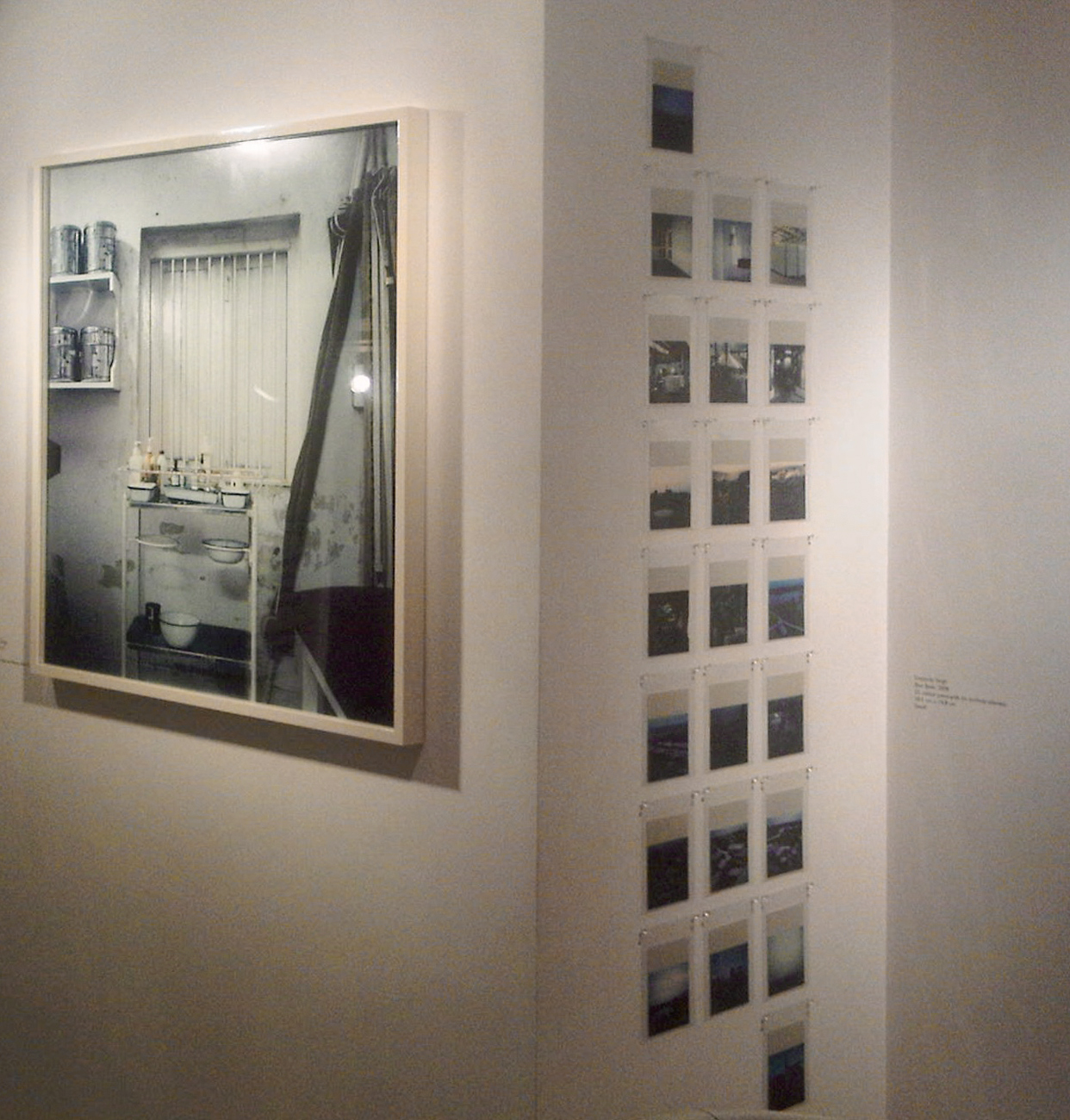
I came to Dayanita Singh’s work driven by an interest in expanded documentary practices, specifically from the perspective of distribution and exhibition. While my focus was primarily on film and video, Singh’s burgeoning experiments with book-making, selling, and display caught my attention. It was the summer of 2011, and I had moved to Delhi for a curatorial residency at Khoj. I was exploring the genealogies and diverse formats of politically engaged, documentary-based work that had entered the spaces of contemporary art in the decade since Okwui Enwezor’s landmark Documenta11, culminating in an exhibition titled Elusive Truth, Evolving Medium: Evaluating Contemporary Political Documentary.
In this regard, I approached Dayanita Singh about her Blue Book (2009) series. My initial response to Blue Book was at the level of the images themselves, and the manner in which they captured a trajectory of post-independence industrialization in India and its effects on landscape, resources and communities. In my first email to Singh, I wrote: “More than a landmark shift in the form of your work, the towering structures and vast machinery you photograph, eerily isolated and bathed in a haunting twilight blue, signify (to me) the remnants of past violence, of capital’s indelible imprint on an unidentifiable yet very specific, living, breathing landscape.” I proposed to include a selection of images from Blue Book, initially imagining prints on the wall sharing a gallery with Simon Chambers’ film Cowboys in India playing on a television set and guerrilla videos by the Samadrushti Film Collective looping on portable media player screens in the passage outside.
The first meeting with Singh transformed this vision. She was adamant that her work was the entire book of postcards and challenged me to exhibit it as such. While I agreed that displaying a selection of images would significantly undercut the careful editing and sequencing central to the work, I had trouble envisioning the book as an object/artwork on the wall. We came up with the idea of taking apart the book into individual postcards, framing each one, but maintaining the organization and entirety of the series. The shoestring budget for the exhibition presented the next hurdle, and I soon realized that I could ill afford twenty-three custom-built frames. I wrote to Singh, who was in Europe at the time, and she sent a one-line response, “Hectic travels but don’t worry will find the appropriate way of showing the postcards for your show.”
Much to Singh’s delight, we circled back to the idea of displaying the book as a discrete object. She recommended nailing the front and back cover to the wall, letting visitors flip through the pages. The book’s design and binding—a series of postcards that were meant to be detached and dispatched—allowed for this kind of manipulability. In addition, she wanted the book to be available for sale throughout the exhibition, for those who wanted to take a copy home and innovate similarly when displaying it on their walls or bookshelves.
As I installed the exhibition, I realized that my initial proposal had sought to disturb the established viewing situation only for moving-image works, playing with scale and screening formats to engage different modalities and temporalities of spectatorship. The dialogue with Singh pushed me to destabilize the conventions for exhibiting photographic works too. Nailing the postcard-sized Blue Book to an empty wall invited viewers to approach the work and handle it in a way that is inhibited in the display of framed photographic prints. It also interrupted the collective viewing apparatus otherwise dominant in the exhibition, demanding visual and tactile engagement at the level of the individual. The context of an independent art space with a relatively small audience permitted intimate and extended encounters with the book, a form of display that would pose logistical challenges in a large museum or biennale setting (Singh’s later projects would address precisely this problematic).
At Khoj, as I watched visitors leaf through the book—running their hands over each image and pressing it down to hold the page—I became increasingly convinced that the significance of including Singh’s work in its intended form exceeded the thematic resonance of the images with the other works on view. Singh’s interventions in the sphere of book design, distribution and display were indeed constitutive of the expanded documentary sensibility pervading the sphere of visual art that I had set out to address.