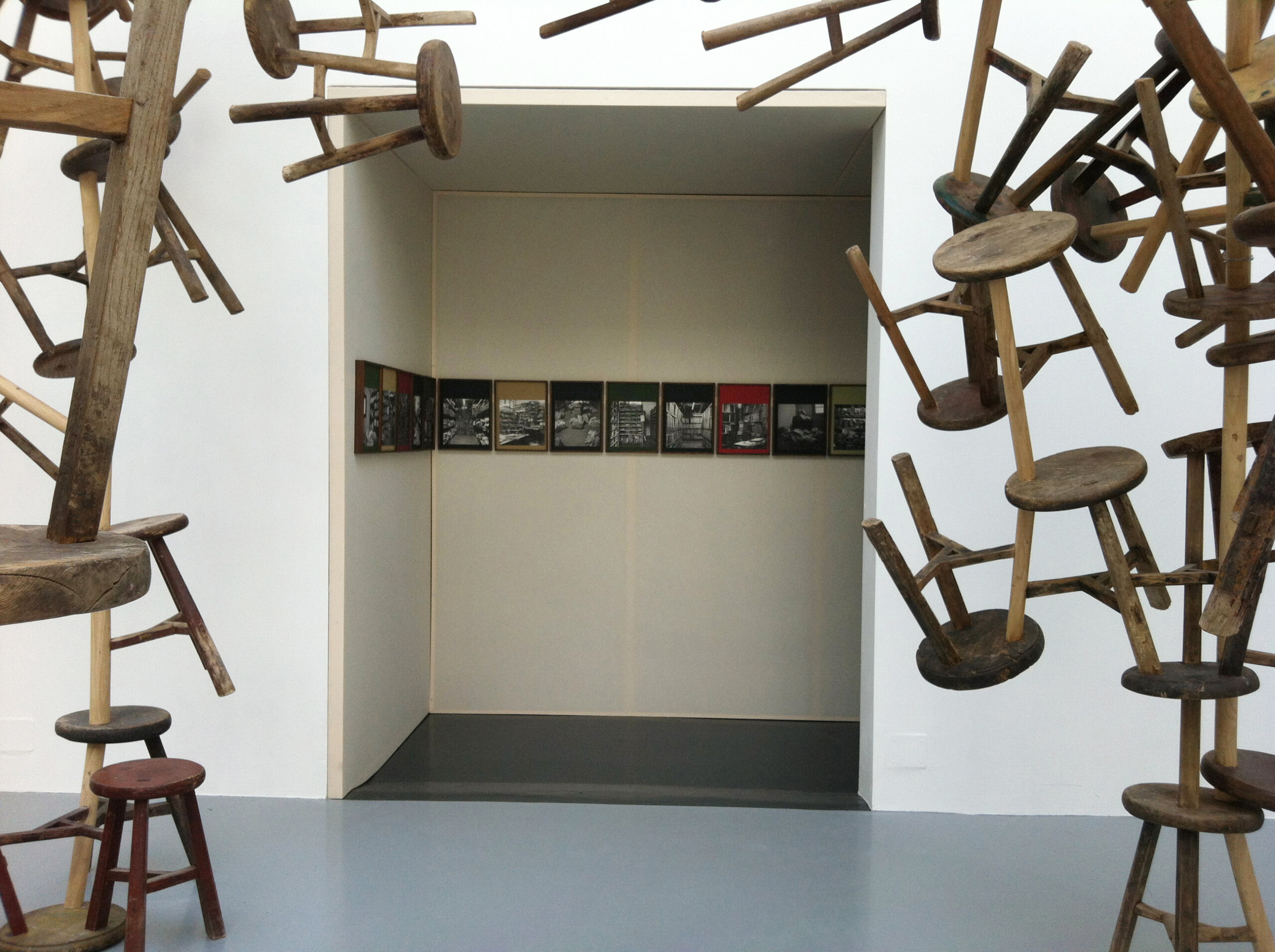
I have written about File Room for years: as a secret, as a fiction, as Mona’s companion, as the birth of photography (Singh its mother), as its portrait. I have written about it as a camera: roomy insides, a contrast of light and dark, a flash before permanence, a continual condition of waiting for someone, or just having been left by someone.
I will write about it again in a year, probably talk about it before that: it is an inexhaustible book. It is inexhaustible because it never exhausted itself.
File Room dips deep into and deep ahead of Singh’s career. In it is the invitation of Privacy (a camera invited into family rooms in which something is withheld for a formal portrait) and the reticence of Go Away Closer (subjects that turn away from you, fold into themselves, or obscure your vision). It is the hinge between the book and the book-object, its pages filled with photographs, its covers drawn from its insides and thrown on the wall, holding behind them the book as a whole. It is the very genesis of the photo boxes, where each image is the framed surface of a photographic ocean. In Pothi Box’s wrapped gauze lies the lesson of its bundles. The colour (so rare for Singh) of Time Measures, itself a photograph, is impossible to conceive without it.
File Room replicates Singh’s recognition, in the studio, of the muscle of her practice that was unknown to herself. The story of File Room goes as follows: Singh realizes, looking at over 200 prints of her work laid out on a table with a friend, that she had been photographing rooms of files. She sets out to feverishly take photographs in factories, record rooms, government buildings, office cabinets, libraries, municipal annexes, cartographic survey departments, tram depots, and lower courts for the next two years. She puts a selection of these together without page numbers, captions, an index, or a list of contents in a book of photographs. File Room proposes the principle of archive—a historical collection of objects brought together by a logic of organization, rearrangement, use, and disuse—as a way to conceive of the history of the practice of photography.
Singh never talks about any of the photographs as individual works (part of her larger project to interrupt the photograph as an autonomous object hanging on the wall), although the implication here is not that each work shouldn’t be closely seen. Rather, a family of works offers each an interior home (the book), which acts as a built context for seeing. Each photograph is, in this way, a unique experience, a world, that is impossible to attend to without the shared experience, or mass, of its peers. We are seeing what Singh saw by working through what she put together.
This offers us a series of important equivalences:
Singh is to Beholder as
Photograph is to Book as
Camera is to Photograph
The relationship between Singh and the beholder is as that between the immediate experience of each photograph (x) in File Room and its organization (y). Singh went from x to y, the offer of y is to lead the beholder back to x. The relationship between photograph and book is the same: x and y move towards each other, back and forth. Finally, the camera, Singh’s Hasselblad, is the first iteration of immediate experience: its insides, a room of inversion, projection, and indelible marking; its viewfinder at waist-level, as the eye of the gut and the womb; its gestative quality (not knowing what’s inside until it comes outside) an analogue to birthing. An extension of the body, the camera is an analogue for Singh’s own presence in the room, the photograph its deferred result on paper (as a negative, as a contact sheet, as a print, as a book).
Photographs, you might have noticed, are on both sides of the equivalences I just introduced. Not only are they cues for immediate experience, but they are also historical remnants (the famous theoretical obsession: “I was there, at that time, in that place, then;” though Singh makes us ask, “was I?”). Photographs are on the side of Singh and on the side of the beholder, to be picked up and touched, opened and closed, seen and felt. They are the unit through which there is movement between Singh and us, a shared experience activated by the photobook.
What is the experience of reading the work? You are looked at, you are looking, you have arrived, you have left. What does it mean to put this together for you? You are Singh the photographer in every image, you are Singh the archivist of Singh’s photographs with every page. The photobook is a bridge between you and Singh.