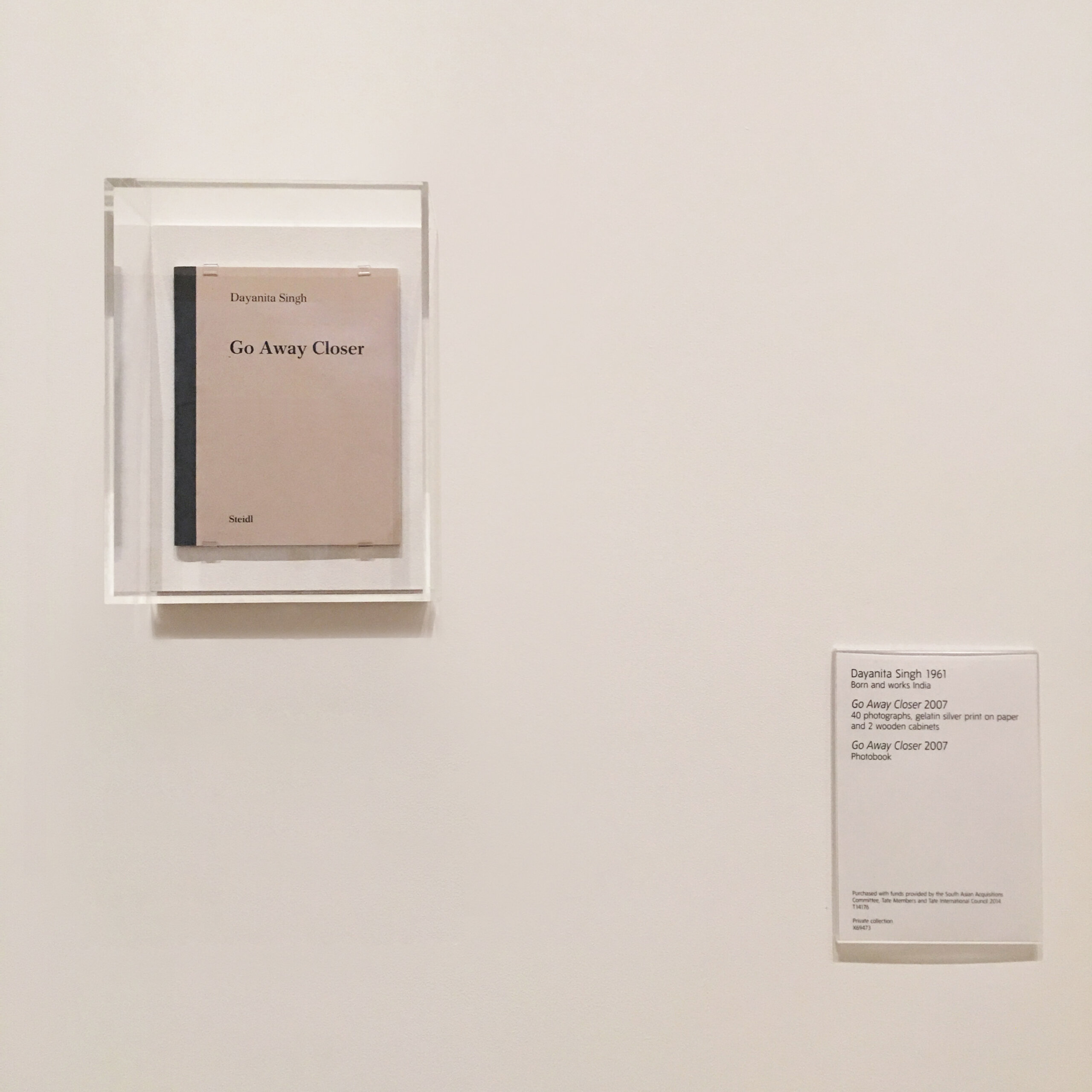
What does one do with a fleeting idea that lights up a moment but threatens to fade away? Or a snatch of a tune? Or a passing phrase that may be the beginnings of a story? A musician or writer will reach for a notebook to quickly record it, pin it down. An artist—a confident and courageous one, whose chosen medium is the book—might explicate the idea in the notebook itself, transforming the notebook into a finished work.
The slim and quiet Go Away Closer is a notebook-book of ephemeral moments. The plain cover of the mysterious thirty-two page book gives away nothing. Like the cover of a music score, it simply announces the title, artist and publisher. Inside, each page contains an image that is suggestive of a mood, or perhaps a musical note. Packed with rhyming, echoing contradictions, the book is playful and pensive; it is about absence and presence. The sequence of photographs is curious and compelling, leading you through vacant movie theatres, empty vitrines, uninhabited palaces and deserted factories. Each of these images holds up a mirror: to a bride’s desolation at her departure from the maternal home, a school child collapsed on her bed in exhaustion, a lone diva on a ramp. They lead you, invariably, to imagine the occupants of the seats of the theatre, the objects that were once housed in the vitrine, the future owners of the rows of scooters in the factory. The photographs are replete with absent people. Who were those people engulfed by the darkness applauding the shimmery model? Was the child burying hysterical giggles in her pillow? In this space between knowing and not knowing, an abstruse and moody composition emerges.
Go Away Closer was published in 2007, the year I was working at Steidl Verlag, in Göttingen, Germany where it was designed and printed. Alone in the city, I would often entertain myself in the evenings in the stationery section of the closest departmental store collecting notebooks and pencils. I imagine that Singh too is just such a hoarder of notebooks. The habit can possibly be traced back to our design school days when the square-grid notebook was like an extension of our bodies. It was no surprise to me that Singh would make a notebook-like book such as Go Away Closer but it must have been a very odd and striking object at a time when photobooks were, by convention, hefty, glossy, captioned and explicated through text. Go Away Closer is unexplained and uncaptioned. The book is held together with staples. Its cover is made of a plain card paper but the images inside, presenting a contrast in form, gleam like jewels, a masterpiece of the printer’s craft too—and perhaps more precious to the eye than a silver print.
At Steidl, I spent a lot of time away from my desk wandering between the scanning, plate-making and printing departments. I wanted to understand why I did not see offset prints of this quality anywhere else. In 2007, Steidl was still holding out against computer-to-plate technology and was exposing film to make printing plates. To my surprise there was only one person for this job; the gentle Rolf helped me make a plate to understand the process better. The printing area, along with a single-colour machine, housed only one four-colour offset press that printed the several hundred books that Steidl published every year. And one man, Gerhard Steidl, directed it all, paying close attention to and experimenting with arcane minutiae such as the fibre of the papers used, the metals in the inks and coatings, the quality of blackness in the black print and so on. It gradually dawned on me that I was at a space that had been created at the precise intersection of an artist’s studio and publishing house, an ambitious laboratory for experiments in book-making. Steidl loves a project that challenges standard conventions of what a book can be. Go Away Closer is an excellent instance of the kind of book that can emerge when an artist responds to this challenge. Its formal schema, brevity and slightness belie the attention it demands. And those who submit to these demands will be rewarded—sometimes with a delicate string of musical notes, sometimes a fugitive visual poem. Things can shift shape here. This notebook of fleet-footedness and transience is also a book of endlessness.