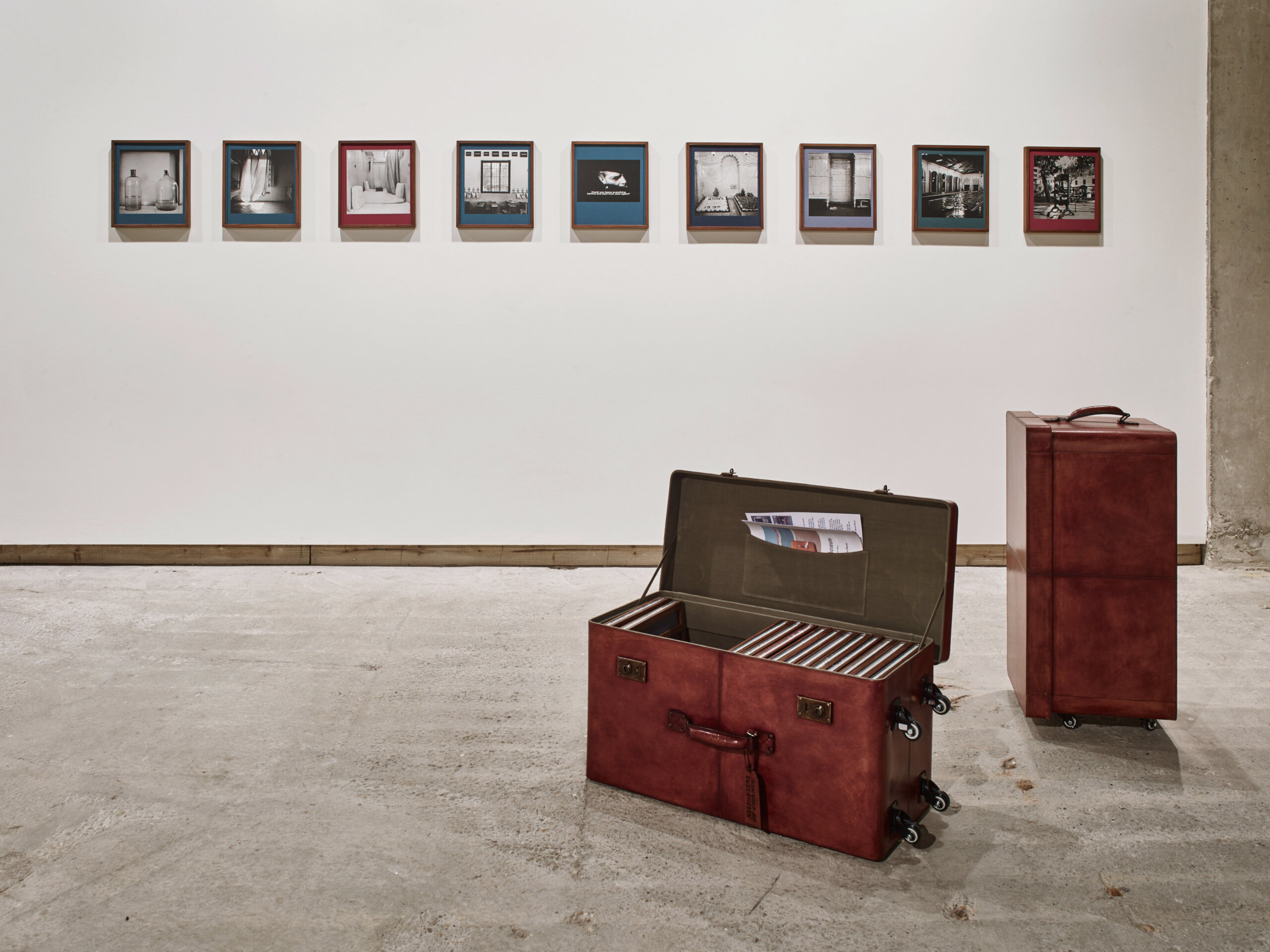
I came to Museum of Chance by way of its book-object. It was just after the monsoon in 2014 and I had recently begun work as the manager of Dayanita’s studio. Dayanita, who had just returned from closing the book with Steidl in Germany, was excited that it was going to have many different covers. She showed it to me, nestled snugly inside a wooden structure. I had no way of knowing then that the book-object was going to define my time at the studio.
Over the following months, I became witness to Museum of Chance’s several journeys across form. I worked with Dayanita on the exhibition note for the book-objects’ very first showing in Mumbai and was present when she created the Museum of Chance book-case. I watched as she designed several iterations of the book-object canvas and leather tote bags, and personally oversaw the packing and shipping for Suitcase Museum’s voyage to its maiden exhibition. I accompanied Dayanita to her booths at the India Art Fair in Delhi and the Dhaka Art Summit, where I assisted her with the book-object edition sales. And, for the better part of three years, I worked under the watchful presence of eighty-eight Museum of Chance book-objects as they hung on the studio’s sliding Book Walls.
Amidst it all, I realize now that I have looked at the book as a book only a handful of times. In my first reading, I was struck by its various textures: the surprising silkiness of its rough cloth, the smooth surface of its cover image, and the grain of the uncoated Munken paper within. I found it impossible to flip through its pages casually and was quickly absorbed by the rhythm of its images and pacing. It was like descending into a cloud or falling into a slipstream: when I emerged, it was hard to tell if time had sped up, slowed down, or become altogether suspended.
Despite that unforgettable first reading, my relationship with Museum of Chance feels inextricably linked to my experience of selling the book-objects with Dayanita in Dhaka and Delhi. At each location, we followed a roughly similar logic and method: we installed the book-objects in rows and then offered them off the wall whilst they were still in exhibition. As visitors arrived, we invited them to choose a book-object with a cover of their liking. Often, I would take a few off the wall to show the front and back covers for options. Once a book-object was chosen, Dayanita engaged the visitor in conversation whilst simultaneously stamping their book-object into edition. She then slipped it into a canvas and leather bag, which she ceremoniously handed to the visitor-turned-collector. From time to time, we would also change the layout of the exhibition, switching the positions of book-objects at random or sliding the books out of their structures to turn their covers around.
Looking at a photobook is a tactile experience in a way that looking at a print can never be. Yet, while recalling all that we did in selling the book-object—in removing it from the wall, in slipping the book out of its structure, in turning it, in packing it, in repeatedly handling it—it dawned on me, only recently, just how deeply Museum of Chance is tied, in my memory, to touch.
Now, familiar images suddenly jump out at me differently: a young girl, a monk, extending her hand for something outside the frame. A woman, arm outstretched, swirling the pallu of her sari on a beach. A man, wailing, his arms elongated above him, brushing the wall behind. A mother nudging her son as they lean into some pillows on a bed. And then: three elegantly shaped bell jars, covered in dust underneath a table—long forgotten, longing to be touched.
My understanding of the book is upturned and I suddenly have the uncanny feeling that I’m descending into an even denser cloud. Repeatedly, the images seem to be pointing me back to hands that, as carriers of touch, lead us into the depths, shades and nuances of something more—connection, intimacy, distance, longing. Love.
I’m left now with the distinct impression that my personal relationship to the book’s images (by way of my physical interactions with the book-object) has become, literally, more palpable. Something a tad more than the usual tactile experience of turning pages and certainly much more than looking at a print. It’s almost as if my act of seeing is slowly transforming into an impulse for touch, and the book is drawing me in:
An indoor pool, enticing me to plunge in; a magical garden staircase, beckoning to me to climb; and three well-lit sinks in a dimly lit cloakroom inviting me to wash, rest and begin, again.
It often feels impossible to describe the thread that binds the sequence and edit of Museum of Chance. Dayanita tends to articulate it as an unfolding that follows “the incidence of Chance”. I have even heard and seen it described as a dream. But to me, it remains strongly a book about hands and the human impulse, desire and need for tactile connection.
Sometimes gentle, sometimes erotic. Sometimes tentative, sometimes maternal. Touch.
Or, as Dayanita once said to me, “that magic hand, Chance”.