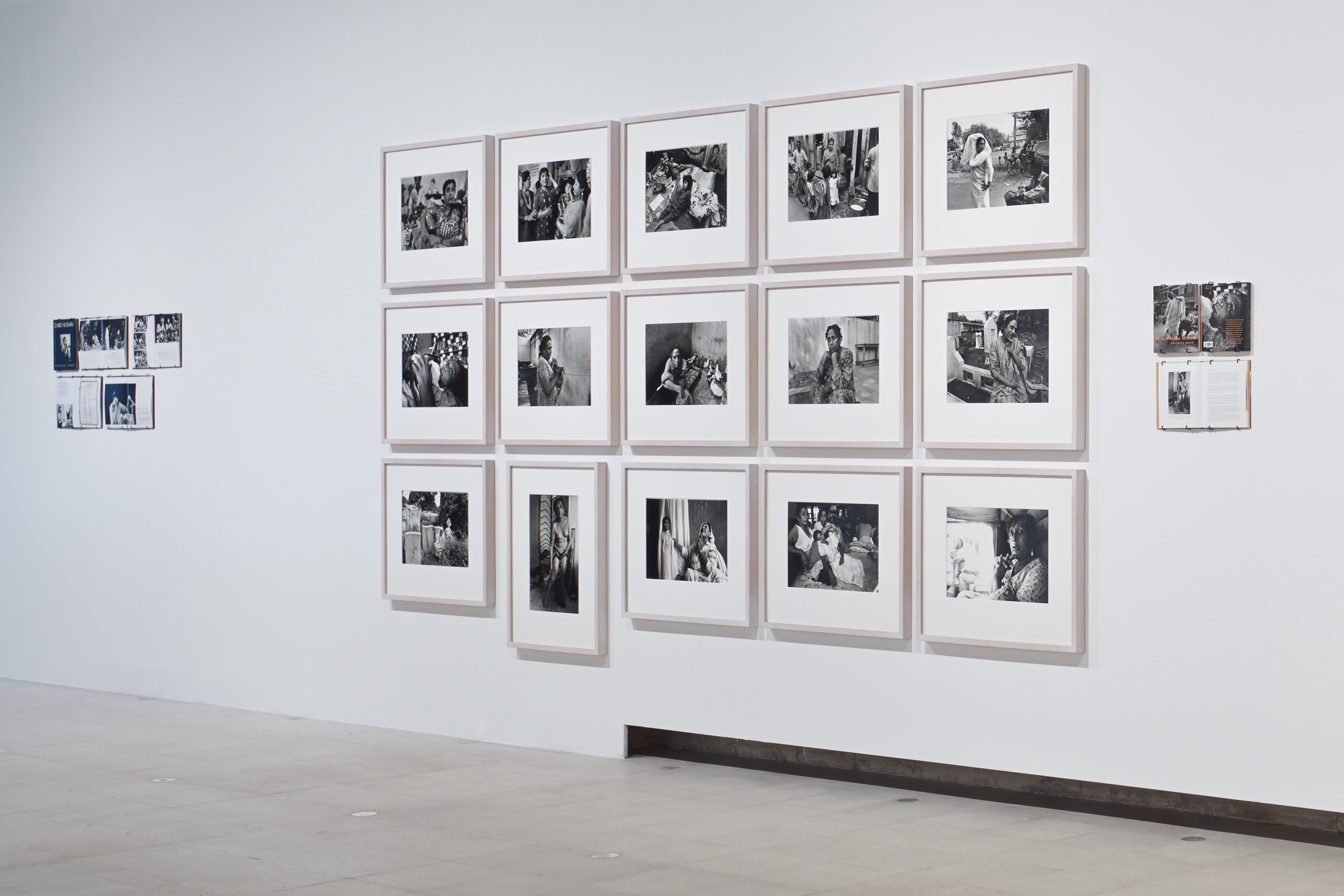
There are some things that only friendship can make possible, and this book is one of those. It is the portrait of a relationship as much as it is of one person, Mona Ahmed. Dayanita Singh often remarks on how difficult it is to give their kinship an adequate descriptor—friend, lover, sibling—words do not suffice. To me, this reluctance to give it a name is a radical act, one that I aspire to, and hope for myself. It is a relatedness that has world-building powers. As a friend said to me recently, “Hope is a practice; it requires work.” This book gives us the tools.
I first found Myself Mona Ahmed in a library and, for two years, each time a reminder to return it arrived in my inbox, I checked the book out once more. It was a somewhat desperate act, I felt I had to keep the book close to me—just seeing it propped on my desk would coax my own imaginative powers. I needed it as proof and witness of what was possible, of the other worlds that existed apart from the one that I occupied: a world in which loneliness is a creative force, an absolute bravery. A world where the friendship between women could transform and reinvent language.
This, of course, has everything to do with its protagonist, whose magnetism also cannot be captured by language. To mark 20 years of the book’s making, Vikramaditya Sahai writes, “Mona takes to the graveyard because she knows that you have to leave one world behind in order to create a new one.” Images from Mona’s home in the Mehendiyan qabristan stay with me: Mona seated next to a waddling of ducks, smiling, fanning herself; her hand on the back of a smooth, tall Doberman; leaning against a wall with special tiling that she has commissioned, fingers gesturing toward an inlay of the Taj Mahal. In a particularly tender series, she dances—the patterned fabric of her skirt held up to the light, arms in the air—among the gravestones. “My attempt to buy false happiness,” she captions this. It is a performance of joy within a bursting landscape of death’s most literal emblems. As she moves, tombstones fleck the scene.
Mona’s departure from the normative is so singular and intense that it jolts and ruptures the present—this is an always-alive present, still visceral even after her death—and in that single moment in which we encounter her, everything tilts. She faces herself in ways that we have been taught not to. She makes beautiful what is almost inconceivable to us, that is, until she shows us it is within our reach. She gathers together the disparate, phantom-like fragments of a single life and builds a palace out of them.
The book begins with two parties: Mona’s daughter Ayesha’s first and second birthdays, in 1990 and 1991. There’s an elaborate buffet; towering reams of jasmine flowers, strung up together in garlands; shining, sequinned fabrics, flashing in Singh’s lens. Mona clutches at her friends, she dances, she lights the many candles of a birthday cake in the shape of a sailing ship. She holds Ayesha, fixing her crown, tidying her dress. She is devastatingly excited, ebullient, bursting with love. Her effervescence lingers also in the images that end the book, where Mona is in the graveyard, shaded by melancholy. “There’s peace in the jungle,” she writes as the last caption, “but I still cannot find it in myself.” In the accompanying image, she is standing in the centre of Singh’s frame, arms crossed behind her back, a slight smirk on her face.
I once saw Mona projected onto a gallery wall. In a video portrait made by Singh, she lies splayed out on a sofa, gently cupping her face in one palm. She is singing very softly, whispering, to the words of a song that leaks into the room. It’s so deeply intimate, we are cast into Mona’s most private and inner space. At first, this feels like a trespass. A friendship is sometimes a desire to fuse, to mirror in each other what we would like to see, to be. A friendship is a departure, a resistance; often, a friendship must struggle to survive. In Mona maybe we see what we hide away about ourselves: our immense capacity for love wounded by a twin ability to carry its hurt. Myself Mona Ahmed invites our trespass, flings open the doors.