The full title of Sent a Letter has a rhythm that gets lodged in my head very easily. When I first encountered this box as a student, on a bright afternoon in the library at the National Institute of Design, I stood for a while turning it over in my hands, without opening it, listening to its pace.
Sent a letter
to my friend
…
On the shelf, the box had looked sober and austere, its plain typography and lack of decoration indicating that its contents were serious, almost official. But in my hands, the worn and smudged muslin covering the box felt reassuring, and I was surprised at how snugly it sat in my palm. As I turned it over, the box transformed into a codex, the words printed across it chronicling a tense narrative of loss, chance encounters, and possible redemption.
Seven little books were nestled within: six with the names of places on their spines, and one with the name of a woman, Nony Singh. So, these are the letters, I thought, and lifting a book out, I realized: it is so tiny!
It was like holding a secret, one that could be stowed in a pocket and taken away. As the book opened softly in accordion folds that revealed a stream of even smaller photographs, I resisted, not wanting to unfurl them all at once. Instead, I settled at a table away from the harsh light of the Gandhinagar summer and went through each book page by page. The pictures were dense to the touch and looked as though they had been pasted in, almost as if the books had been assembled by hand.
As I attempted to decode the links between them, I found myself imagining my own journeys through Padmanabhapuram and Calcutta, with a friend I met in Bombay and later left in Allahabad. A cast of characters began to emerge, and I spread the books across the table to accommodate them, creating little rooms that opened out to long hallways, and stage sets where they exchanged passages I had scavenged from other books on the library shelves.
A clever librarian would have placed this box far away from the photography section: perhaps on a shelf of fiction, to hint at its infinite narrative possibilities; or in the architecture section, as a tool to explore world-building; or as an intriguing box of paper movies for those browsing a shelf of cinema.
I had really wanted to believe—and almost did—that this was a box of lost and found letters that had somehow ended up in a college library, if not for the inescapable fact that it was a published work. Gradually, I began to observe how meticulously every detail had been planned, and this made it more interesting to me as a student. Something important was being revealed to me here: it can be done this way too. A book with photographs did not have to be large and shiny, or even be about the photographs at all.
A few years later, when I was living in Kolkata, I went to visit Satramdas Dhalamal Jewellers on Park Street, in whose window I knew Sent a Letter was on permanent display. It was an exhibition I had walked past many times in the decade it had been on show, but I had thus far failed to really notice it, probably because I had not expected to see an art exhibit in a jeweller’s storefront.
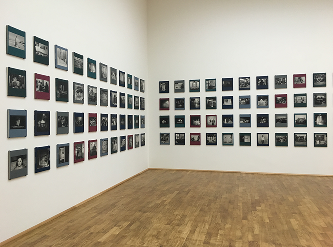
Now, standing outside the large glass window with the mid-afternoon sun reflecting the busy street behind me, I peered at the fan-like accordions displayed on shelves of different levels. The photographs, already small, now looked smaller, like dark polished stones. This was no longer the playful and intimate world of lost letters and interconnecting stories. Here, the little paper books stood gathering dust, forming a quiet, elegant tableau. As I walked away, I felt unsettled, even disappointed.
Why had seeing Sent a Letter displayed in a shop window affected me so deeply? For many years, I reasoned that it was simply because I had been unable to engage with it as I had in the library; separated from me by a sheet of glass, it was out of reach, and therefore inaccessible to me in the ways I had known and loved it.
But then I realized that galleries and museums the world over had regularly shown this work in much the same fashion, and I had never found those exhibitions troubling. It was only when I began to concern myself with questions of dissemination, accessibility, and reach within my own practice that it finally dawned on me: in that storefront, Sent a Letter had been deliberately shorn of its revered status as a precious art object.
Away from the carefully curated, shrine-like spaces of the gallery, the museum, and even the library, it had to work to catch the attention of casual passers-by who sometimes engaged with it, but often did not. And yet, the little books had managed to remain patiently on display on the most famous street in Kolkata, in an exhibition that had run longer and had had more visitors than any artist could have hoped for.
In refusing to simply acknowledge me as a devoted pilgrim, it had continued to quietly provoke me. And now I was finally able to understand—and learn from—what this seemingly unremarkable exhibition had been able to do.