In 2017 I curated ‘Everything we do is music’ at the Drawing Room, London. The exhibition explored Indian classical music as a source of inspiration for a host of modern and contemporary artists. Indian classical music developed through the oral tradition. Unlike in the West, there is an absence of any notational system, no score to act as an originator of action. Instead it consists of ragas, which have a particular arrangement of notes, but with an improvised delivery. The performer has the freedom to multiply or slow down the beat, the notes can be elaborated and extended. A raga is not simply recited, and its inherent melodic framework calls upon every performance to become an act of creative exploration, with its own distinct temporality.
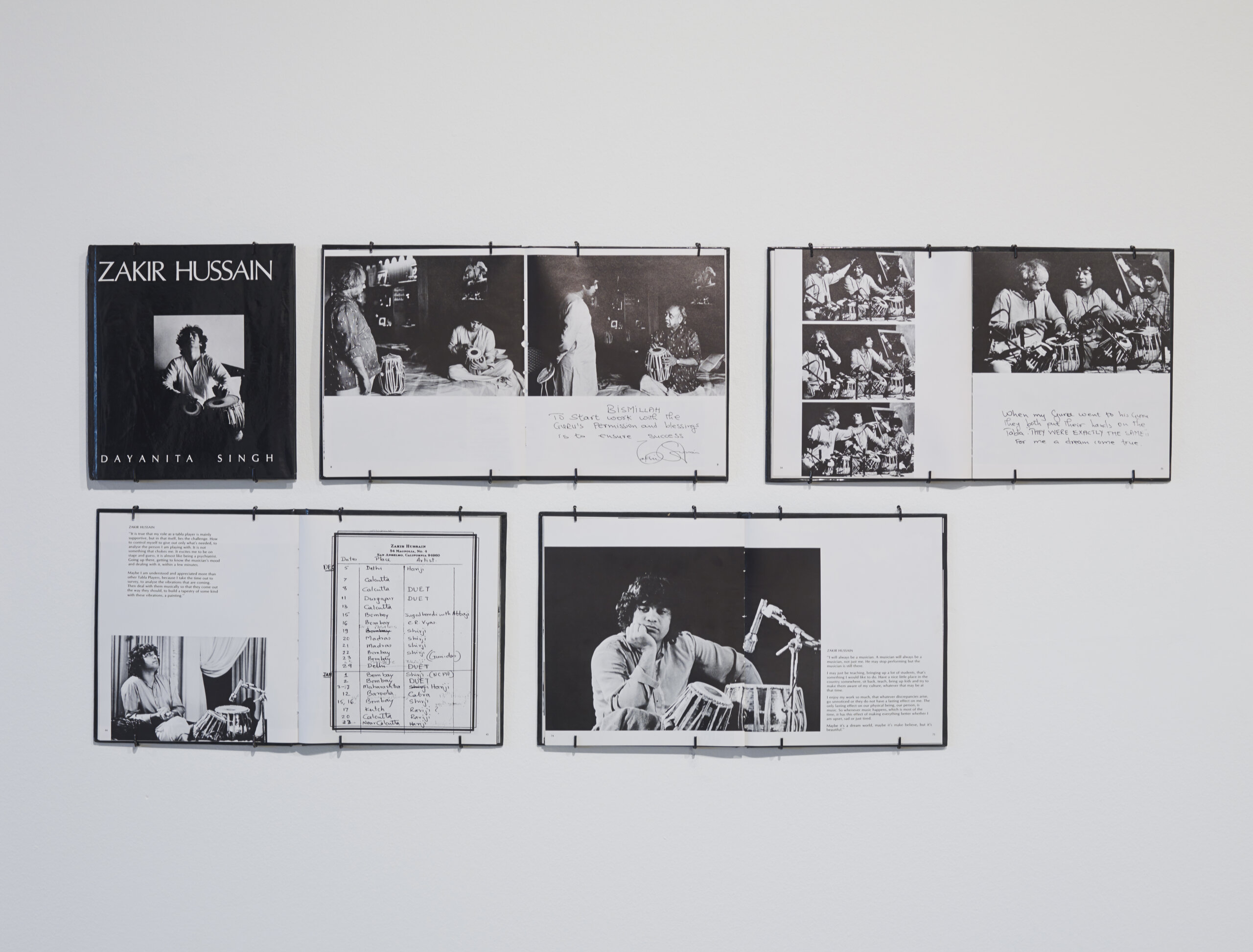
‘Everything we do is music’ sought to consider how artists, through their work in various media, evoked the unique features of ragas. From figuration through to abstraction, spanning ragamalas made in the 17th century to new commissions, a diverse range of approaches were on display. And at the heart of the exhibition space was a vitrine with the maquette for Dayanita Singh’s first book, Zakir Hussain.
It was following Singh’s 2013 survey at the Hayward Gallery, London, in which she exhibited a copy of the book, that I became personally familiar with Zakir Hussain: A Photo Essay. When asked to contribute a text for Parkett in 2014 on Singh’s practice, I proposed writing on Zakir Hussain, which until that point had not received any scholarly attention, in part due to the fact that Singh herself had till the Hayward show renounced the book. The curator of the Hayward exhibition, Stephanie Rosenthal, gently convinced Singh that she should include the book. Slowly, Singh overcame the embarrassment she had been carrying with her about the book for more than two and half decades, and recognized that many of the chief preoccupations of her practice were already in place with Zakir Hussain—the focus on an extraordinary individual, an intuitive quality when it comes to editing, bridging the gap between word and image. When I wrote to Singh that I would be concentrating on Zakir Hussain for Parkett, she responded: “I am so happy you remembered the Zakir book, it’s the key.”
A few years later, when putting together the checklist for ‘Everything we do is music’, it seemed only natural to include Singh and Zakir Hussain. The book is a cross between a family album and a diary; the boundaries between the private and professional worlds of Zakir Hussain the musician dissolve across the slim volume. Singh’s internalisation of the core tenets of Indian classical music in Zakir Hussain is most visible in the non-linear sequencing of images. Her cropping, enlarging and isolating of elements; the absence of any obvious repetitive patterns; minimizing the use of the grid, every page designed individually; the varied scale and placement of the images and text—all of these were akin to the controlled ascent and descent of the delivery of notes of a raga by a musician. In her wilful resistance to the prevailing conventions of photobooks, in Singh’s elliptical and inventively evasive strategies, a modernist impulse can be detected.
Singh and I had previously discussed her never having made exhibition prints of the images in Zakir Hussain. Those images had to be encountered as they existed in layout, in relationship to one another, in the form of the book. It appeared that I would have to present the book in the exhibition in a manner analogous to the Hayward show. Nevertheless, our exchanges and some of my more specific questions about the actual assembly and design of Zakir Hussain prompted Singh to search out the dummy for the original book. The maquette itself had survived all these years because of Singh’s mother, Nony Singh, who had preserved all her papers.
On 31 January, 2017, I visited Singh’s studio, and was presented with a neat black folder, and alongside it a copy of Zakir Hussain. In the folder were not only the diary notes Singh had made when the assignment was given to her class by Vikas Satwalekar, but pages of every layout in the entire book. Reviewing these unfinished galleys, which Singh had made with her own hands—cutting out prints, gluing them to the sheets of paper, pencilling notes—the instinctive construction of the book became palpable. Every imperfection and accident that can be removed digitally today is visible—rubber solution residues, marks from old tapes.
My impression of what had been shared with me was not just a blueprint for a finished book, or a template, but a personal act of creative negotiation. It needs to be underscored that it was in a book design class that Zakir Hussain was born, not in a photo studio. The maquette offers an unbridled insight into how Singh “learnt restraint from Zakir” and sought to apply it to her own work.
Instantly, I requested Singh to let me exhibit the maquette instead of the book. Access to the maquette felt like a privilege. The maquette would be the perfect foil to all the ‘resolved’ works in ‘Everything we do is music’. An object to be appreciated as embodying or making manifest the artist’s attempt to translate an understanding of Indian classical music into a visual artistic form.
A little hesitant, because of the delicate condition of the maquette, Singh was eventually persuaded when I volunteered to be the courier of the maquette to London, and then back to her studio in Delhi. Following ‘Everything we do is music’, Singh and Gerhard Steidl, as part of their on-going professional collaboration, decided to make a one-to-one facsimile of the maquette and it was released in 2020 as Zakir Hussain Maquette. The fidelity of Steidl’s reproduction of the maquette’s artisanal qualities is notable, and seductive.
Both Zakir Hussain and its maquette, now that their historical moment has passed, can be understood more deliberately, in the context of Singh’s own oeuvre but also when it comes to photography and the trajectory of the photobook in India. What has also emerged is the status of the maquette as distinct from the original edition of Zakir Hussain as an object. It is its own aesthetic artefact. Moreover, on closer review, there are three pages in the maquette that Singh did not include in the final published book. Does this make the maquette a different version of the book? Not the rough cut to the director’s cut? Can it be assumed that the published book is not the complete version? Can Singh’s second thoughts be privileged over her first? It seems necessary to make note of these ontological issues raised by the very physical presence of the maquette and its contemporaneous facsimile because it tests the rationalization that the published book is the definitive version. Consequently, Singh’s act of a dual recovery of Zakir Hussain and its maquette is a testament to how comfortable she has become in adapting the fractal complexity of Indian classical music to not only individual works, but also to the interrelationships between them.