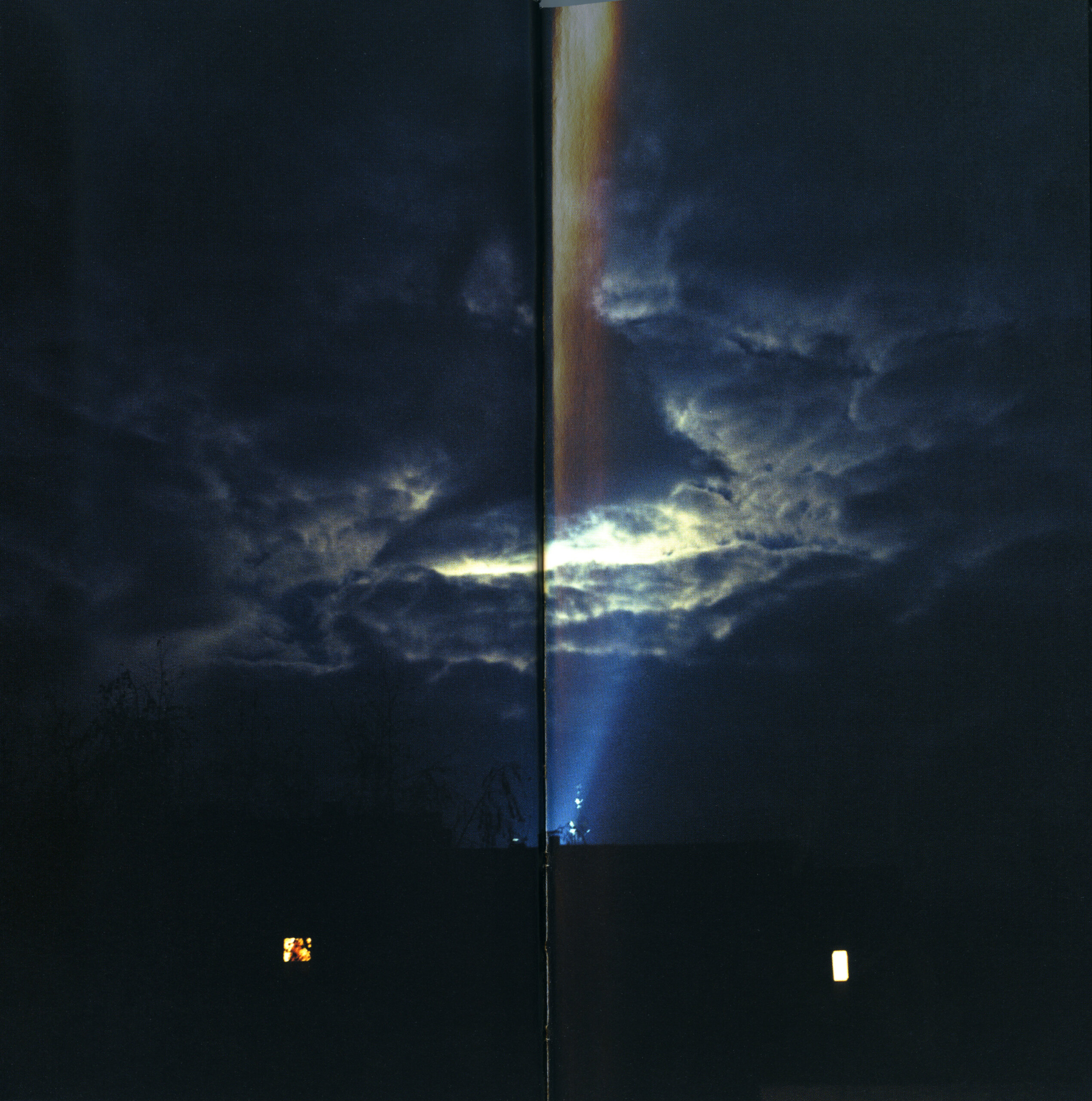
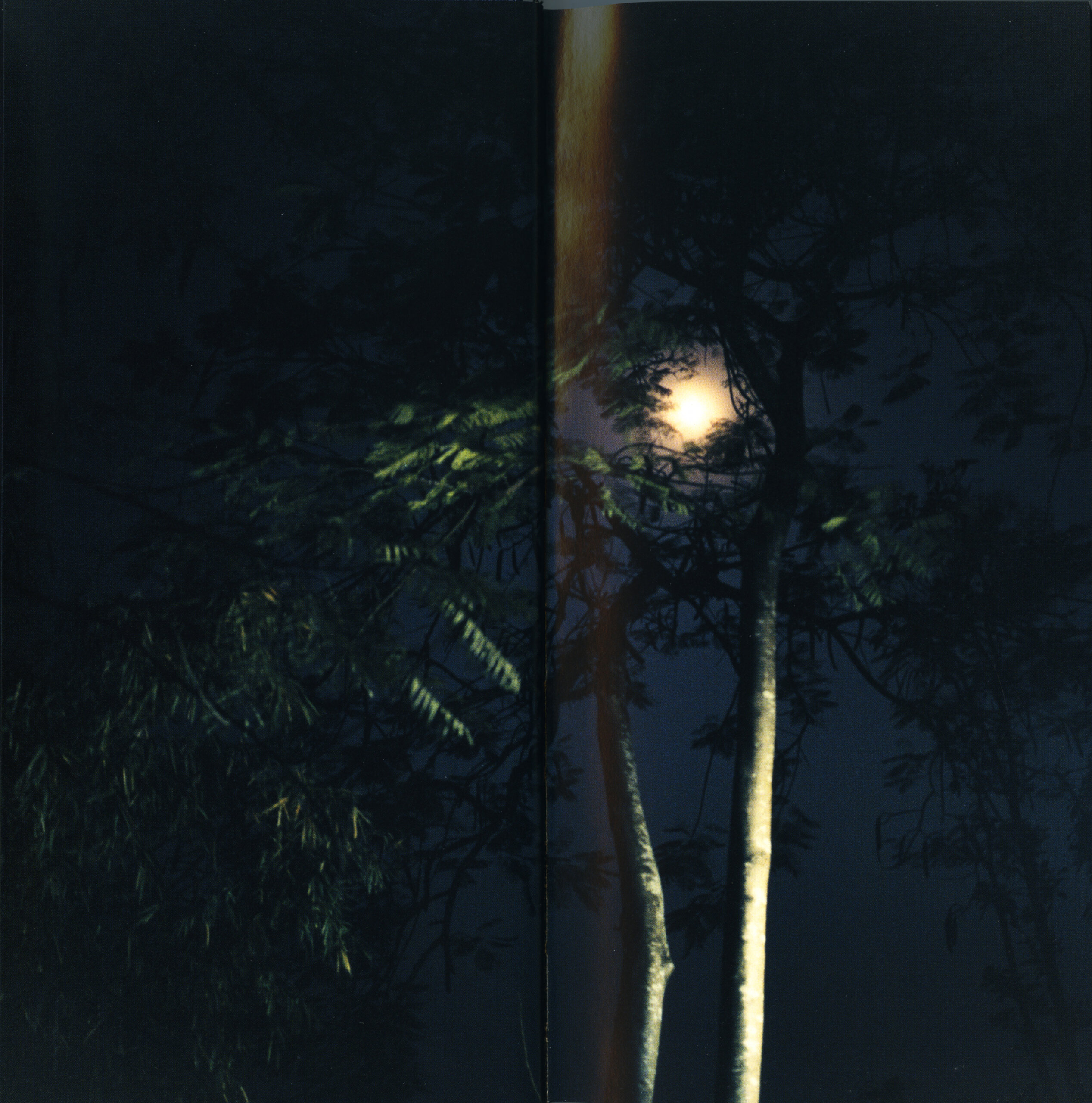
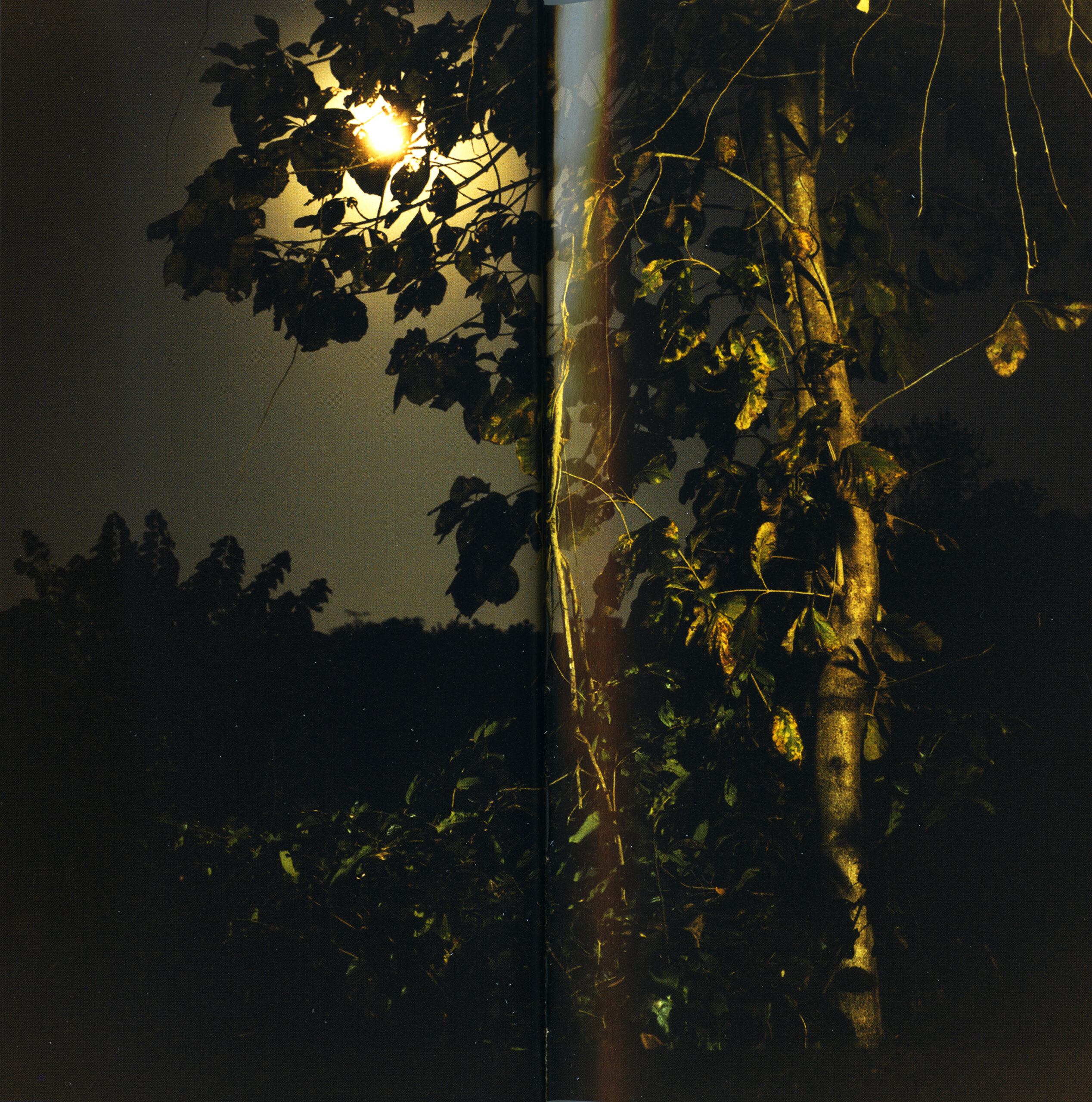
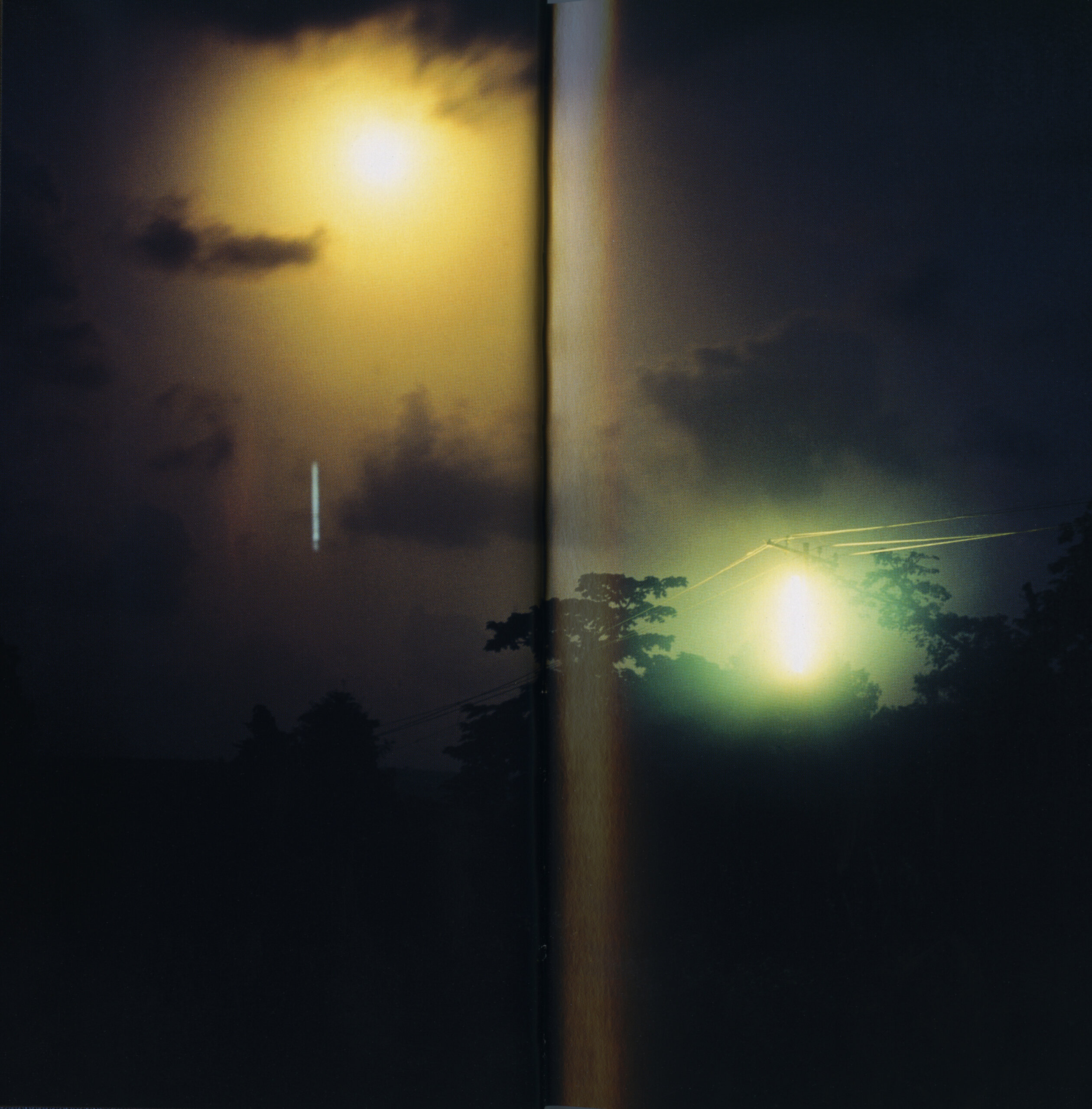
Thunder is good, Dayanita, thunder keeps you awake.
—Gerhard Steidl
When Singh turned to colour in the late 2000s, she began a series that photographed the different ways in which the night comes alive. Later, she fashioned these images into Dream Villa, a nocturne that both emerges out of and dissolves into a world of Singh’s imagination. Equal parts wondrous, fantastical and ominous, it explores the many ways in which the night transforms when it is illuminated and electrified by artificial light.
Outwardly, Dream Villa is everything that a photobook should not be. For one, it has an odd, oblong shape, much like a telephone diary or a travel journal, and it is tightly bound so that it does not stay open on its own. Its photographs fill double spreads in perfect squares but the gutter consumes part of each image, almost gash-like across the middle. Its glossy paper creates a sheen, causing each of the pages to reflect onto each other.
Like Blue Book (2009), Dream Villa’s images have luscious colours and could easily have been fashioned into a larger book. Yet, Singh opted, once again, to create a more intimate and private experience. While Blue Book sits delicately inside the reader’s hands, Dream Villa fills them for a more abrasive, stubborn effect. The book’s tight binding, size and shape prevent the reader from casually flipping the pages—it is only possible to move from image to image if you open, close, and open the book again—creating a slightly claustrophobic, staccato viewing experience.
Singh was clear that she wanted these images to be full-bleed, knowing that white margins, edges and space would deaden the nocturnal images’ dramatic quality. Initially, this created a design problem. The options were to either keep one page blank and then do a bleed, or to put two full bleeds side by side. However, neither worked: the former created a preciousness around each image while the latter fused two photographs across a spread, forcing them to be read together as one.
At Steidlville, Singh sat on the issue for two or three days until, one morning, she folded each of her image cutouts in half and pasted them back-to-back to create a quick dummy. Realizing she had arrived at an unorthodox resolution, she took it to Steidl and said, somewhat as a challenge, “Now, Gerhard, even you won’t publish such a book.”
He paused, looked at it and then replied, “This is exactly what we’re going to do.”
There was something in the unconventionality of this solution that agreed with Steidl and Singh. They both appreciated the perversity of running the gutter through the middle of the image, which, in any other book would be considered a sacrilegious decision. The tight binding further enhanced the presence of the gutter and the stubborn unwillingness to remain open gave the whole book a sculptural quality.
The constrictions added a frustrating element to the viewing experience, simultaneously disrupting each image while also enhancing the book’s unsettling tone. And since Singh had long stopped using page numbers, the reader was forced to build their own vocabulary around each photograph.
Dream Villa, stark and stubborn, is a book with agency. A book that insists on being read on its own terms.