The entrance of Dayanita Singh’s residential building opens into a foyer with an elevator in the centre. At the foot of the stairway, to the elevator’s left, a single, framed black-and-white poster with a close-cropped image of two musicians is nailed to the wall. The words ‘Zakir Hussain’ announce themselves in bold red in the middle of the poster, with ‘dayanita singh’ emblazoned in teal below them.
From the foot of the stairway, a similar frame with a dancing figure is visible on the first landing. Here, ‘Myself Mona Ahmed’ is inscribed in red with ‘singh/scalo’ in ochre below. As one climbs the stairs to her apartment, a new poster appears at every winding turn, revealing a modest poster retrospective of all of Singh’s books.
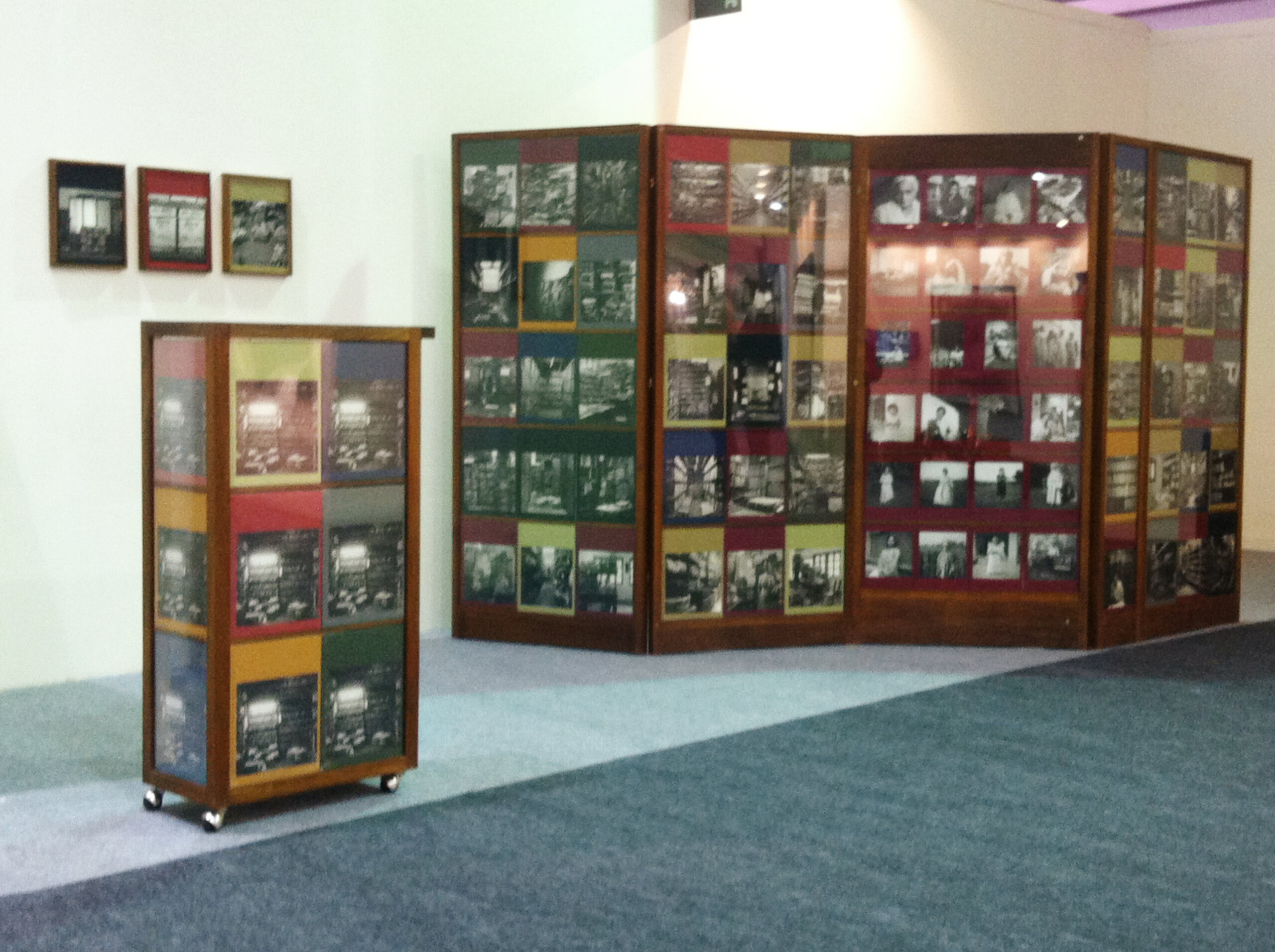
On the first-floor landing, a wooden Book Cart has found a permanent place just outside Singh’s home. Currently, it is lined with copies of File Room and its collapsible signing table is folded into its slot on the top. Underneath, near the cart’s handle, a drawer full of stamps and coloured ink-pads waits to be opened, lying dormant and quietly anticipating the opportunity to be activated once again.
A few feet from the cart, by the entrance of Singh’s flat, a slim, floor-to-ceiling teak vitrine-shop is filled with all of Singh’s books. A small window, slid shut, is built into the white front door beside it. Underneath the window, the words ‘Singh/Steidl’ appear in grey.
Inside the studio, the entrance room transforms into an ever-changing gallery. On three sides, its walls are covered, from floor to ceiling, in grids of book-objects. A full set of 70 File Room book-objects hang to the right of the entrance way, while a full set of 88 Museum of Chance book-objects hang to the left. Singh calls these her ‘book walls’.
Closer inspection reveals that these are not conventional walls. Built in two rows, they consist of sliding panels that stack into layers behind each other or adjoin to create an uninterrupted expanse of book-objects. Sometimes, the walls slide out to conceal or reveal entryways to other rooms. Singh plans to add more rows of panels as she continues to create more book-objects until, one day, there is just a small passageway left to access other parts of her studio.
The stairway of Dayanita Singh’s residential building is host to a modest poster retrospective of all of Singh’s books.
I – Book Posters
A small poster retrospective of Dayanita Singh’s books greets visitors as they enter her residential building. Beginning with Zakir Hussain, visitors are able to journey chronologically through her book oeuvre as they climb the stairs, culminating in a poster of Museum of Chance on the second-floor landing. This can be done without entering her apartment or her studio.
“The chronology of the books is a chronology of my life,” Singh says. “Anyone coming to my house will know the importance that the book has played in my life when they walk through the poster exhibition in the stairway.”
Acutely aware that her silver print work is inaccessible to the larger public, Singh sees the poster form as a more accessible means of disseminating her images in large sizes.
When the ‘Go Away Closer’ print series was shown in exhibition in Delhi, Singh was unhappy that her silver prints were not accessible to her friends. As an alternative, she made a poster of the girl on the bed and offered it to anyone who came to the gallery. It still hangs framed in several homes.
The poster form provides a new entryway into Singh’s interest in the relationship between text and image. Here, the text in the poster does not detract from the value of the image for Singh. Instead, it actually adds to its richness as it provides a context, clue and alternative reading. This is particularly so as her book titles are often laden with meanings that are larger than any of her individual images and works: ‘Go Away Closer’, ‘Privacy’, ‘Dream Villa’, ‘Sent a Letter’, ‘Museum of Chance’.
In providing a form that allows Singh to combine text and photograph—which in the traditional art market would reduce the economic value of her image—the poster becomes a vehicle through which she is able to offer her images at a fraction of their market cost.
II- Book Cart
In the summer of 2013, Singh convinced the Prince Claus Fund to ship her Book Cart from New Delhi to Venice. Singh was one of four artists to exhibit at the Deutscher Pavillon (German Pavilion) of the 55th Venice Biennale that year and she wanted to celebrate File Room by releasing it in close proximity to her installation.
On the day of the opening, Singh wheeled the Book Cart just short of the entrance to the exhibition in a pink ‘Go Away Closer’ sari. She opened the wings of the cart to create a ‘T’, revealing books and bags stowed on the shelves within. She lay a white ‘Go Away Closer’ cloth on the top of the cart and arranged an assortment of stamps to create a signing table. Soon, a small crowd gathered around her. The legendary curator Okwui Enwezor addressed the crowd and released File Room.
Singh spent the next few hours selling her book from the cart outside the exhibition. She spoke to each visitor as they stepped up to the cart to make a purchase, stamping and personalizing the front page (and in some cases the cover) based on each conversation.
For €30, visitors bought a personalized book directly from Singh and then proceeded to find the very same book shown on the walls inside the pavilion.
The Book Cart is more than just a bookshop on wheels, it is an integral form through which Singh activates and performs her books. Here, the structure of the physical cart plays two crucial roles: first, it places Singh at the centre of the sale of her books, allowing her to take both symbolic and practical control of where her books are disseminated and sold. Second, it allows her to develop a specific set of conditions and circumstances surrounding the actual process of sale.
By the time Singh took the Book Cart to Venice, she had already developed a set of rituals surrounding the Book Cart. Yet despite the specificity and ceremony with which she performed the exchanges in Venice, the evolution of her performative work with the Book Cart has a humble origin story.
Singh first premiered the Book Cart in 2011 at her House of Love opening at Nature Morte, New Delhi. For this inaugural occasion, she lined the cart with the House of Love book. The book was released that evening with a House of Love cake, which was cut and shared with the audience by a good friend whom she had designated as the ‘cake-keeper’. She wore a jacket with an image from the book printed on it. At the end of the night, her pockets were full of the money she’d made from the many copies she sold that evening.
In deliberately playing the role of photographer, artist, book-maker, distributor, gallery and seller, Singh attempted to both symbolically and practically create a new space for her books in the book and art world. Where in Chairs she took charge by circulating the book through a distribution chain of gifting, here she took the sales into her own hands.
It was after the success of this first iteration that Singh began to give the cart a more deliberate performative tone and quality. In the weeks following, she rolled the cart around the India Art Fair, where she and four friends sold House of Love to the general public. For this iteration, Singh added layers to what had begun to take shape as a ritual selling of her book. This time, the cart was lined with 20 copies of House of Love that were each covered in a unique dust jacket made using images from the book. All the collaborators, Singh included, wore matching House of Love jackets inscribed with text and handed out the purchases in bags of Singh’s design. Once done for the day, the cart was placed in the Nature Morte booth, where it was offered as an artwork for sale. Nobody acquired the cart, but it found a place and an afterlife in Singh’s home, reinforcing the presence of the book to everyone who visits her.
The Book Cart had far-reaching consequences on Singh’s overall artistic practice. As the first mobile structure she ever built, it is a direct antecedent to Museum Bhavan’s large wooden structures. Moreover, the Book Cart set off a chain of performative events that Singh would incorporate into the launch and selling of each of her subsequent books and book-objects. Each built on the ritual and ceremony of the one preceding it, with all the books and book-objects having their own unique mahaul in which they were sold.
In fact, these early Book Cart events demonstrated that she could infuse each of her books and book-objects with meaning and significance specific to the time, place and conditions of each exchange. For example, traces of her conversations with individual collectors can be found in the selection of stamps she made for each sale, while the deliberateness with which she packed and handed them the bag added another layer of connection between her and the collector. In each instance, the ritual, process and experience of the sale imbued the book or book-object with a distinct memory or residue of the mahaul of each event.
None of this would have been possible without the presence of the physical structure of the Book Cart, which enabled Singh to have an architecture around which to anchor her events. In many situations, it served as a kind of podium, allowing for the theatre of sale to unfold around it.
Now she, the artist, was exchanging money for her book in art world spaces and was performing her books to create further desire for them.
III – Bookshop: No Book, No Entry
In a natural progression, Singh expanded the idea of the Book Cart and built a permanent bookshop for her books at the entrance to her flat in New Delhi. More conceptual in design than in practice, it consists of a narrow teak vitrine shop and a small sliding transaction window in her front door.
The bookshop was opened for a short period when groups of museum trustees first began making artist visits to Singh’s home. Before they entered her studio, every trustee was asked to acquire a book from the shop outside. Two groups refused on the grounds that never before had they paid to meet an artist, but Singh stood her ground: no book, no entry. Singh lost the key and the bookshop has been locked ever since.
“I made the bookshop more as a conceptual exercise, to say to collectors that they could only engage with me if they understood that the book was the heart of the work,” she says. “I thought, how interested can you be if you do not own a single book of mine?”
IV – Book Walls: Architecture, Form and the Studio
There are 2 complete book-object exhibitions on permanent display in the entryway of Singh’s studio. 70 File Room book-objects hang on one side of the room, while 88 Museum of Chance book-objects hang just opposite.
The book-objects are installed in grids, on floor-to-ceiling panels that are attached to the roof of the studio on a sliding mechanism. These ‘book walls’ form the conceptual bedrock of Singh’s constantly ‘changing gallery’.
The book walls emerged from Singh’s initial experiments with form seeking the facility for simultaneous display and storage. Her interest was primarily to find ways to build archive-exhibitions in compact spaces but the book walls opened the possibility of working within a myriad variety of spaces. “I think I had already understood that I could change the architecture of a space with the museums I built,” Singh explains, “so I move the walls back and forth depending on how I want a visitor, or even myself, to experience the space of my studio.”
But the decision to find a solution for storage within a form of display also reveals Singh’s desire to keep her images alive through a variety of book forms in both her professional and domestic space.
“I wanted to see if I could live with my books over my prints,” Singh says. It has been 6 years since she built the book walls and she has yet to tire of repeatedly seeing the books every day. For her, the book on the wall holds her attention for longer than a print because she’s aware that there is “a promise of more” behind the front cover of every book-object.
“Perhaps all the pages inside give the book a pulse,” Singh says, “an almost haptic quality. Somehow the book never gets fossilized like photographs behind a glass.”
The book walls embody Singh’s endeavour to be part of both the art and publishing worlds without being confined to either. In combining display and storage, print and book, exhibition and archive, conceptual concern with form, the book walls propose a new architecture with which to live with the book works.