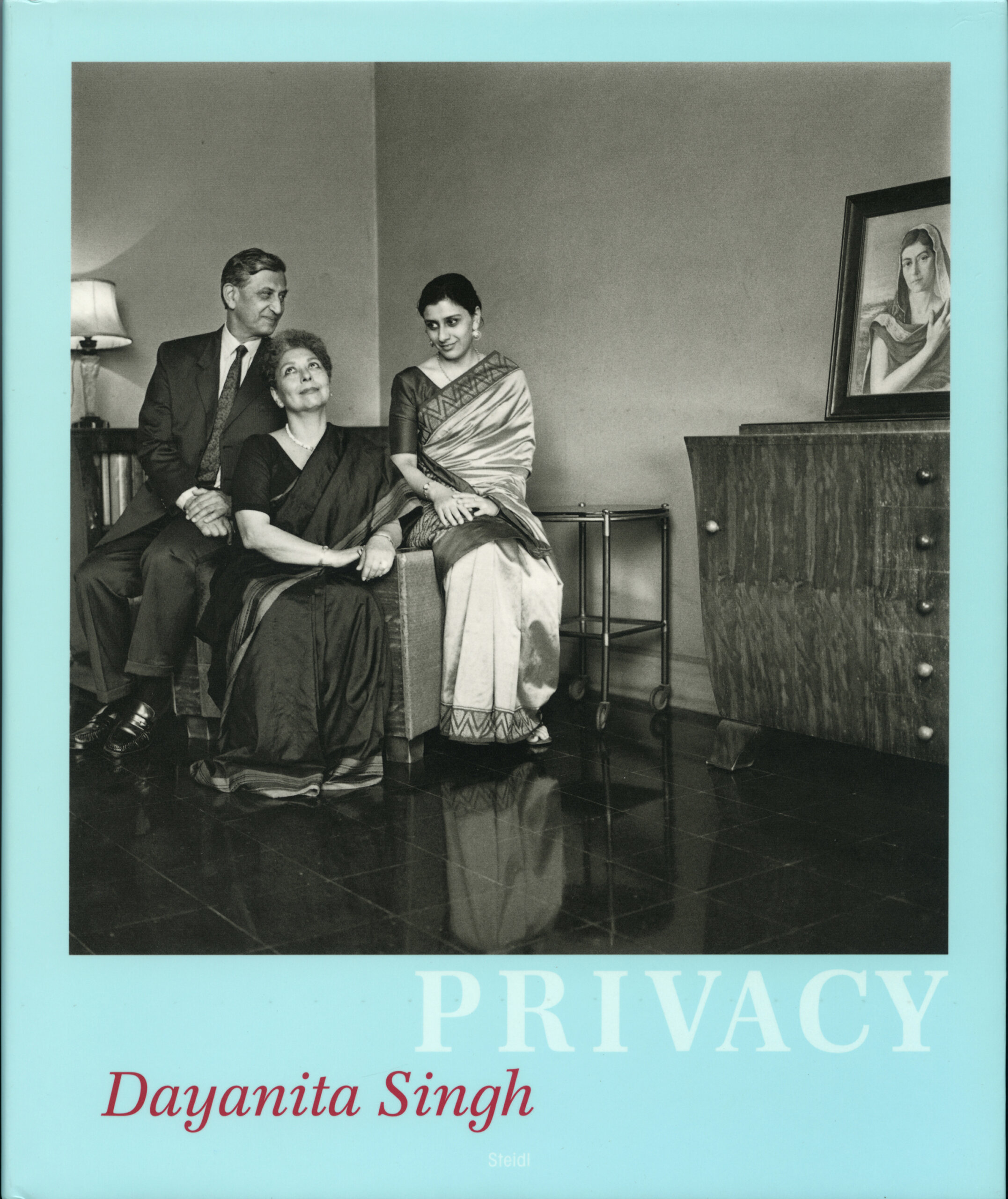
“Exhibitions come and go but the book is forever.” – Gerhard Steidl
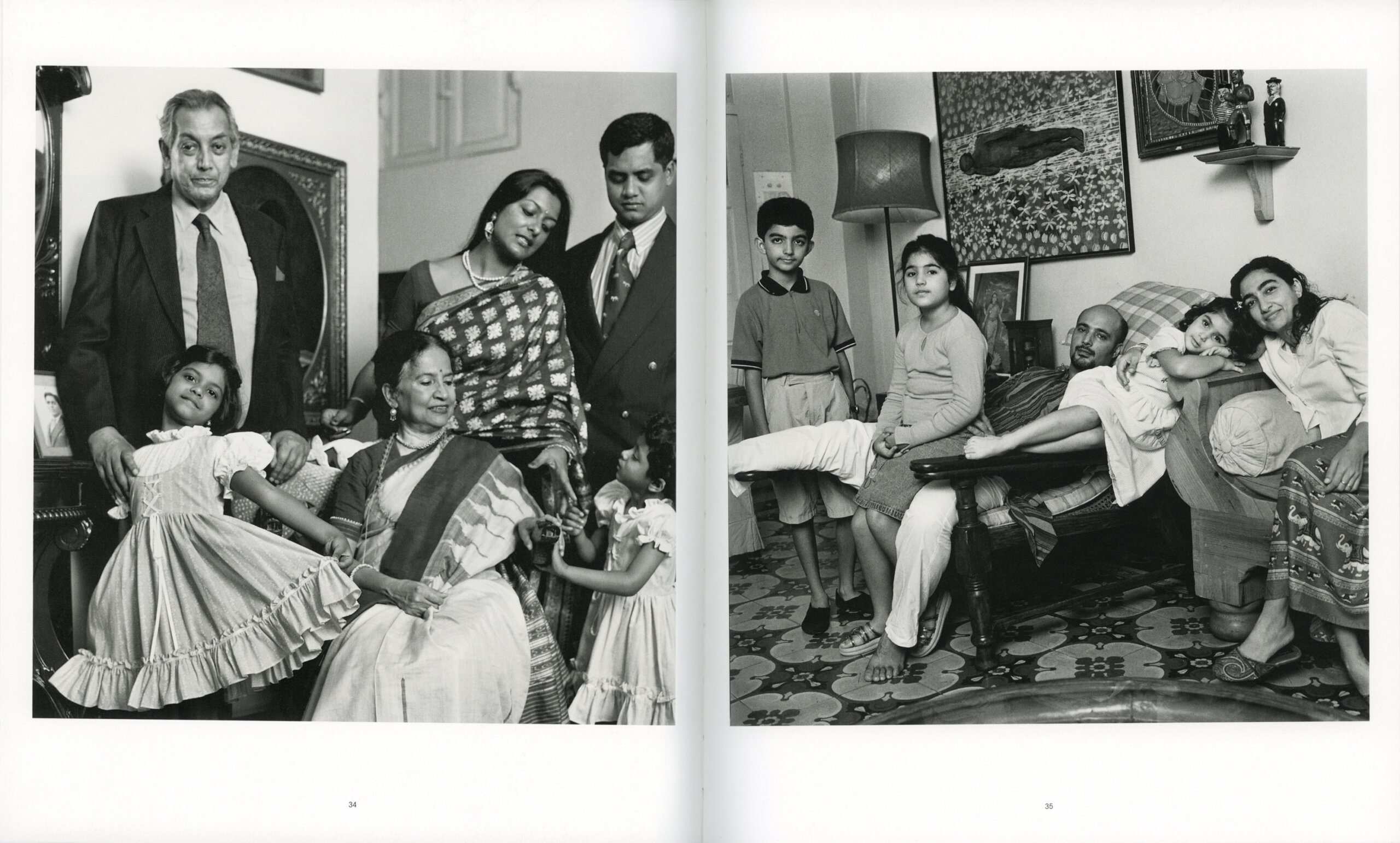
Privacy arrived approximately a decade after Singh made the jump from photojournalism to a different kind of photography, when she was making family portraits of middle and upper middle-class Indians. She started, first, by photographing her friends, then friends of her friends and then, eventually, the “friends of friends of friends”. She made the images to give to the families as prints for their family archive and not for a series she was making as a photographer.
Initially, Singh was convinced that nobody other than the families would be interested in the portraits, but a generous grant from the legendary photographer Robert Frank affirmed a sense of confidence in herself. She used the unexpected gift to dedicate herself entirely to the project, stretching the amount across the span of three years. She spent her days living on friends’ sofas while saving the grant money for travel, film and printing. But most crucially, the funding enabled Singh to gift the families their portraits as large prints that they were compelled to hang on their walls.
In 2002, Singh was invited to show her Privacy work—both the family portraits and empty spaces—in an exhibition at the Hamburger Bahnhof Museum in Berlin. Steidl agreed to make the accompanying publication and Singh went, for the first time, to Gottingen. Steidl asked Singh if she wanted to make a catalogue or an artist’s photobook. He told her, “A catalogue is what a museum wants, as a record, but an artist’s book is where the artist makes all the decisions.”
At that moment, Singh knew that this was the form where she could be the author of her entire work and her obsession with the book began. With exhibitions, Singh felt she was limited by what curators wanted for her work but the book, as a form, offered her freedom from what the art world expected from photography.
“When I work with Steidl,” she explains, “I can determine all aspects of the book: not just the images but what the texts are, what the paper will be, how the story is told, how the narrative is built. Steidl is interested in what the artist brings to the book.”
Perhaps Singh’s training at the National Institute of Design, Ahmedabad readied her to receive Steidl’s ideas and expertise. “I think he could see that I understood design, paper, binding and typography in a way that other photographers did not,” she says. “I had learned how to learn from my training with Zakir Hussain and I am still learning from Steidl.”
Singh considers Privacy to be her first immersion in all the technicalities of book-making. Steidl is unique in that his printing press is located within the same building as his design and publishing office. In fact, he once famously said, “At the top, you throw in an idea and, after a few days, a finished book tumbles out a few floors below.”
Privacy is printed in tritone on a Xantur paper that Steidl helped develop. It has a clothbound cover in a deep sindoor red and its dust jacket is set in the exact shade of Tiffany blue. It has corresponding images on its front and back: the photograph on the back cover is the same scene as the portrait on the front, only without the people. When removed, the dust jacket can transform into a small poster or mini-exhibition of the book.
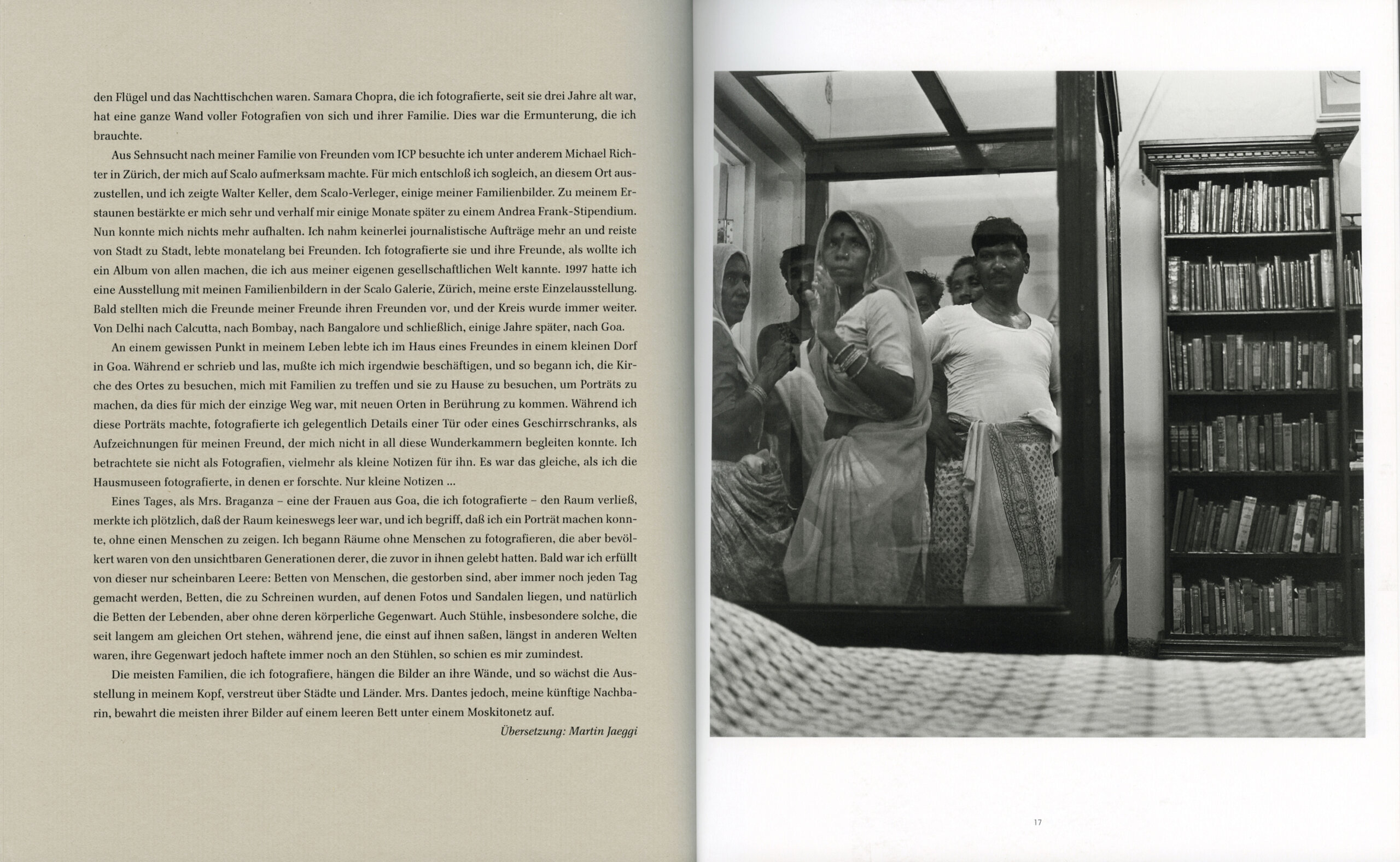
There are 2 texts in Privacy: an essay written by curator Britta Schmitz, as well as an introduction that Singh wrote overnight at Steidl’s request. Since both texts are related to the images but are not integral to their reading, they are printed on a pale brown hemp paper to separate them from the rest of the book. Similarly, the image captions are not placed near the images but are listed in a section on the same hemp paper at the end. Singh had wanted to put a long list of acknowledgements but Steidl urged her not to and offered to one day publish an entire book of her acknowledgements.
In a departure from more traditional narrative storytelling, Steidl and Singh used other rhythms and structures to guide the image sequence of the book. “We could have sequenced them by place, by age, by sheer form, all of which Gerhard said NO to. Instead, he took out scissors and scotch tape, laid out the prints on his very long table and we got to work,” Singh says. They made the sequences as if they were writing short pieces of music and, as such, Singh considers Privacy to be a series of “movements” within a larger symphony, with Steidl at the head as conductor.
It was in the making of Privacy that Singh understood that a photobook cannot be created without a maquette and that it must be handmade. The process of physically making a maquette allows for many accidents along the way, pointing to new possibilities for the book, its sequence and form. Singh still works with A4 sheets today, folding them in half and pasting her photos onto its pages to create a sequence for her works: cutting and pasting, again and again, until the work is “ready to be birthed”. And through it all, being prepared to start all over again if need be.
The title of the book plays a key role in Singh’s book-building process, as it often helps guide and tie together the selection and edit of images. Here, the word ‘privacy’ alludes to several complexities that Singh negotiated as she made first the photographs, then the exhibition and, eventually, the book.
There is, to begin with, no equivalent word for privacy in Hindi, but the title also hints at a kind of ambivalence that Singh sometimes felt when she made the family portraits. Occasionally, she wondered if she was intruding into her subjects’ lives and homes and, in the process of making the book, contemplated whether it was appropriate for her to publish family photos that were intended for private family archives.
Yet, Singh has always worked with a gentle and graceful consideration for her families and here, perhaps, the images provide a clue: the care with which Singh negotiated the metaphorical distance required to retain a family’s privacy is often reflected in the literal distance she maintained between herself and her subjects in their portraits. Never too close to intrude and yet close enough to retain some intimacy.
This is also reflected in Singh’s descriptions of her portrait-making sessions, which are reminiscent of the process she later established for the selling of her books and book-objects. In both instances, she crafted a set of self-created rituals that serve as a kind of preparation: a structuring or creating of conditions within which a meaningful exchange can unfold. In Privacy, it is the photographs that carry a trace of this intimacy, not unlike the memory and residue that the sale of the more recent book-object editions imbued.
Ultimately, Privacy offers a different kind of photo-biography, providing a glimpse and an entryway into a deep, abiding relationship between a photographer and her subjects. It is a book of enduring resonance: a work that transcends its early affiliation to an exhibition and certainly one that has outlasted any catalogue.
Singh continues her conversation with several of the same families even today, seeing and photographing many of them over the decades as they lived through birthdays, marriages, pets, divorces and deaths. An ongoing project that is a witness to passing time, as the little girl in the frock turns into a young woman with a little girl of her own.