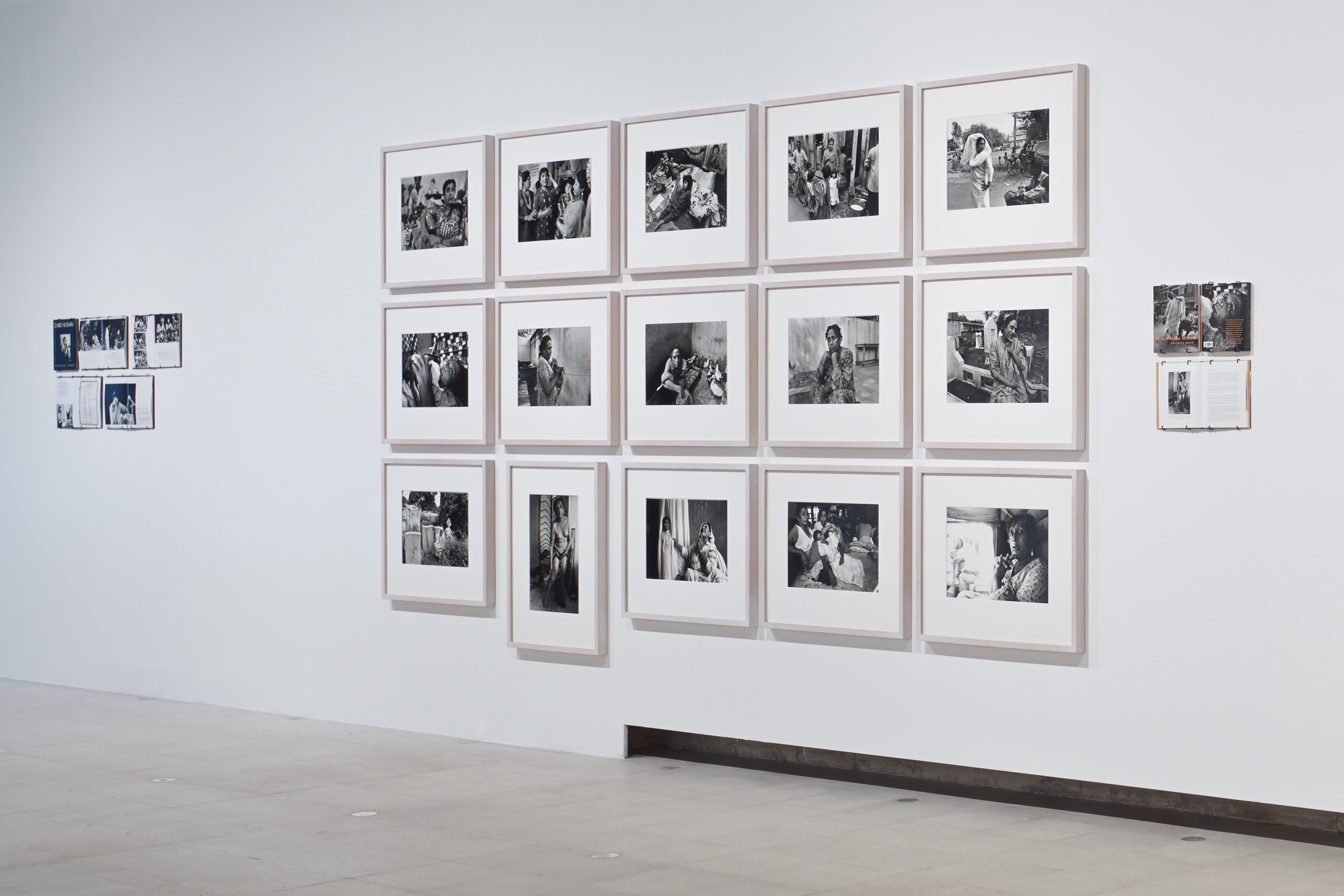
Dayanita says that Mona was a gift that she got from photography. Mona and Dayanita were gifts that I got from the documentary. I had met them while working on the documentary Three Women and a Camera (Sabeena Gadihoke, 1998). I can’t remember what came first—our introduction to Mona or the photographs that Dayanita took of her. So fascinated had I been with the photographs, that Dayanita generously gave me colour photocopies of a number of black-and-white photos that I have since lovingly preserved for my private contemplation. Most of these photographs later became part of Myself Mona Ahmed, which, in my opinion, remains one of the most significant photo-chronicles of a transgender person at the turn of the 21st century.
Sabeena and I met Mona several times with Dayanita. We would meet either in Dayanita’s apartment or at Mona’s home in the graveyard. We had heard that Mona could be volatile and temperamental but, when the three of us were together, she was always warm and affectionate. Notwithstanding her imposing appearance, her ability to empathize could be profoundly comforting. I experienced this when she attended my mother’s memorial service. But of our many meetings, the memory of one remains particularly vivid. Myself Mona Ahmed was going to be launched at the graveyard and Mona had taken charge of the arrangements. When we arrived for the occasion, an exuberant Mona welcomed us with loud greetings and garlands. The place was teeming with friends, neighbours and passers-by, and the air was festive. Everyone, including Mona’s beloved goats and rabbits, seemed to be wearing garlands. A brand-new white Maruti van had been put on resplendent display. A disapproving Dayanita explained that Mona had already spent a large part of the money she had earned from the publishers to buy the vehicle even though she did not know how to drive. It had been bought to be parked permanently at the graveyard as a symbol of her success and to induce envy in her now-estranged family of Hijras. Dayanita predicted that the car would stand there and rust, and it did. But such grim prospects did not bother Mona. That day, as late afternoon melted into darkness, Mona flew from one side of the expansive graveyard to another, singing, dancing, performing and making impromptu speeches. The intoxicating mix of food, drinks, music and Mona’s larger-than-life, theatrical presence overwhelmed each of us.
The heady celebrations of the book launch reminded me of the “Early Ayesha Photographs” in Myself Mona Ahmed. In my review of the book for Biblio (May–June, 2002), I had described this photo-cluster as follows:
The “Early Ayesha” photographs are clearly the happiest photographs in the book. They are mostly carnivalesque in nature, documenting the elaborate birthday celebrations of Mona’s adopted daughter Ayesha. The mise-en-scène brims over with plentitude and jouissance. Beautiful bejeweled hijras revel in Mona and Ayesha’s happiness.
The photographs in Myself Mona Ahmed follow a broad chronology but are not arranged according to specific themes. For the purposes of the review, I had sorted the photos into the following clusters: “Early Ayesha Photographs” (pages 18–46), “Ayesha Grows up with Mona” (pages 54–62), “Impending Estrangement” (pages 68–82), “Mona’s Alienation” (pages 87–94) and “Life in Exile” (pages 98–106).
The arc of the book bears witness to Mona’s gradual estrangement from her family of Hijras and eventual exile to the graveyard. The happy intimacy of Ayesha and Mona’s early photographs becomes haunted by an imminent foreboding, as they sit on the roof of their Turkman Gate residence. A thoughtful and melancholic Mona looks around her absent-mindedly as Ayesha stares into the camera or looks up at the sky. In subsequent photos their bodies touch but their gazes diverge as though they were contemplating separate journeys. The final section of the book is about Mona’s self-imposed exile in the graveyard with pets and transients as her companions. Framed against the urban wilderness and silence of the tombstones, Mona, with her quiet dignity, stages her own alienation for Dayanita’s camera.
One of the most compelling photographs for me is the “selves’ portrait”, a precursor to the selfie, where Dayanita stands with Mona’s head resting on her shoulder. The caption reads: “When I feel like dying because I cannot bear the world any longer, Dayanita gives me love and encouragement.” (page 14). With these lines, Mona would have spoken for both of them. Without her I would die. Because of her I live. When in 2017, in a country far away, Dayanita watched on her phone Mona passing away, it was one friend staging for the other her final exit. The death of a friend is never the death of friendship. Myself Mona Ahmed and Dayanita’s future works will be seared by this realization.