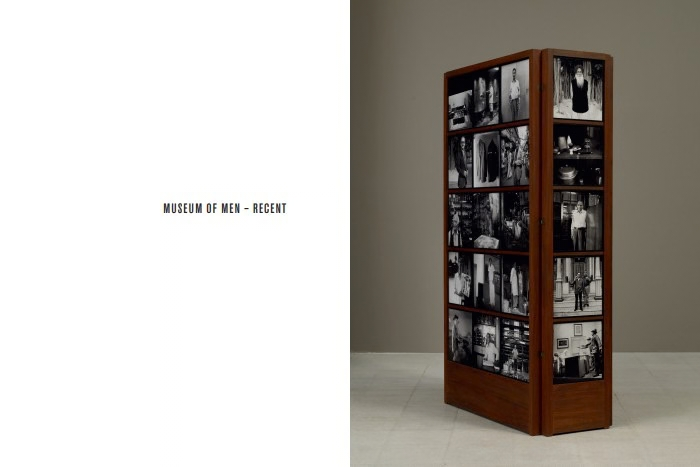
Teak structure and inkjet prints
One large structure:
189 x 109 x 48 in
Five small structures:
32.5 x 32.5 in (each)
73 prints:
30 x 30 in (each)
Installation image credit: Simon White
Teak structure and inkjet prints
One large structure:
189 x 109 x 48 in
Five small structures:
32.5 x 32.5 in (each)
73 prints:
30 x 30 in (each)
Installation image credit: Simon White
Sometime in 2007, I found myself hanging around listlessly in a gallery in Calcutta trying to get interested in the paintings on the wall. It was a dull afternoon high above the noises of the city, and there was nobody else in the gallery. Suddenly, I sensed the entry of another person. Turning around, I met what seemed to me simply a pair of very large, and very open, eyes. Everything else – room, pictures, body, sex – seemed to have fallen away from this pair of eyes, which were engaged in looking at me with an intensity that transformed me, in an instant, from person to presence, so that the same things – room, pictures, body, sex – seemed to fall away from me too. It wasn’t that this visitor looked ‘straight into’ me, as the cliché goes. She had taken in all of me. Held in that gaze, I felt I had, for a few sharp moments, become my own essence, but had not been reduced to that essence. Nor had she made me feel naked or embarrassed by the directness of her look. I remained fully myself, standing half-bored in a gallery in Calcutta, but it was as if my ‘context’ had ceased to exist for her. She walked in briskly, indifferent to the art on the walls, and did not stop as she gave me that stare, before moving past me to disappear into the office without another backward look. There was an amused curiosity, and a total absence of politeness, in that look as well. She did not smile at me. It was an encounter outside the sociable. If I had never met her again, I wouldn’t have been able to recall the other features of her face, person or attire (I think she was in white). But what did etch itself on my memory were the unnerving openness of her eyes, and their intensity of focus. I felt that if she hadn’t looked at me like that, I would have been less than fully present in that moment, even to myself. Somehow, she had got the point of me.
*
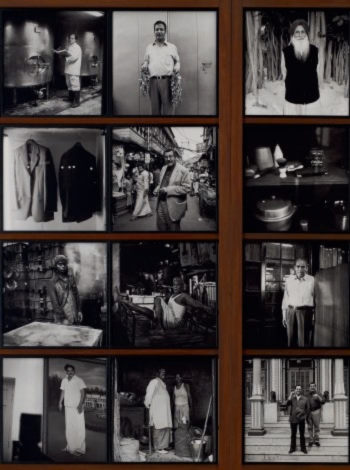
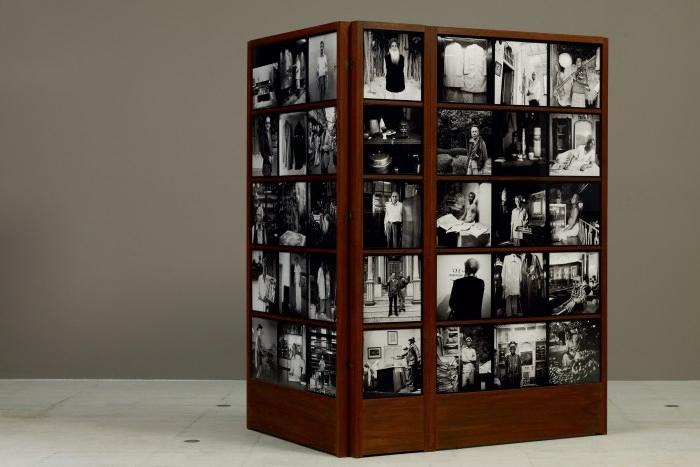
The photographer’s encounter with her subject is a moment of recognition that is at once inscrutable and has, folded into it, a sequence of gradually defining moments that together make up the full realization of the portrait in a larger body of work, or in more than one body of work. Recognition: the word itself is marked with the prefix of repetition – knowing again what we already knew, seeing again what we might have seen before. Our familiarity over time with different bodies of work by the artist could make a face, an expression or a gesture the object of a gradually sharpening sense of déjà vu. A character who appears in House of Love a number of times reappears in the Museum of Men, standing between tombstones in a ruined cemetery. A bespectacled man stands facing a goat in the Museum of Men, but comes back again in the Museum of Photography, this time facing a camera on a tripod in a bare old studio. We notice how the fine comedy on the face of another man in the Museum of Men turns into gentle drollery in the Museum of Photography, as he holds burning incense sticks in one hand and a monograph on photography in the other, of which he appears to be an unlikely reader. None of the men in these portraits is identified in the Museum of Men, although their undated and unlocated anonymity is played off against our recognition of more iconic presences, usually represented as photographs of formally painted portraits. Sometimes, the identity of a relatively more renowned photographer, writer or publisher might glimmer out to those who know them. But that, too, is left to chance, as the famous, the unknown and the obscure are all gathered in the embrace of the museum to create a genuine democracy of faces, expressions, gestures, postures and settings that is inclusive yet finely tuned to human idiosyncrasy and individuality.
The idea of recognition, for both the artist and her viewers, is taken, therefore, beyond the particular historical identity of the subject towards the perception of a quality that is altogether more mysterious and elusive. What is it that brings and holds all these various men together within a single museum? Does this quality reside in the men themselves, or is it what the photographer seeks and finds in, or projects upon, each. It becomes the One in the Many that eludes verbal articulation, and turns on its head the conventional taxonomy followed in most traditional museums and archives of the world, where names, places, dates and other kinds of historical information are crucial for the purposes of ‘documentation’. It is, instead, through a series of unnamed and unplaced human encounters that we are gently compelled to recognize gradually a sense of unclassifiable kinship and connection in the Museum of Men. We begin to see and know and cherish, through the singularity of these sequenced encounters, a form of embodied and individualized, and therefore richly historical, knowledge, without our being allowed to define in conventionally discursive or curatorial terms what exactly this might be the knowledge of.