Teak structure and inkjet prints
One large structure: 230 x 80 x 56 in
Five small structures: 40.5 x 40.5 x 10.5 in (each)
73 prints: 38 x 38 in (each)
Installation image credit: Simon White
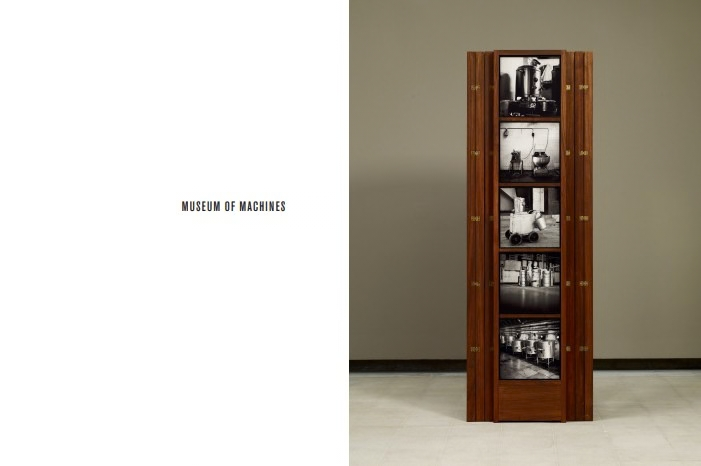
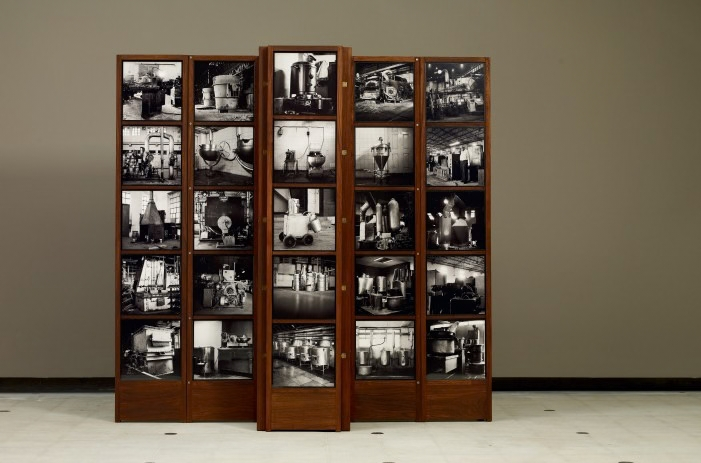
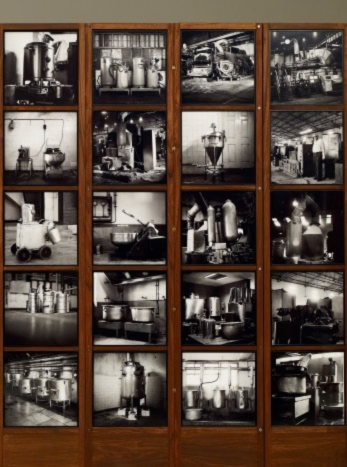
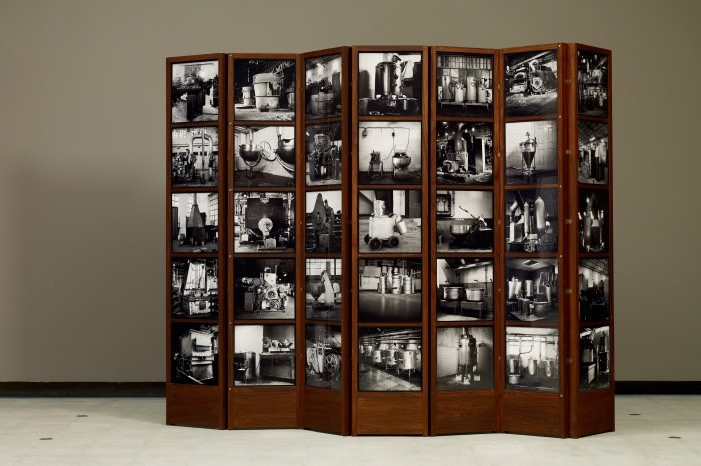
Teak structure and inkjet prints
One large structure: 230 x 80 x 56 in
Five small structures: 40.5 x 40.5 x 10.5 in (each)
73 prints: 38 x 38 in (each)
Installation image credit: Simon White
What would the architecture of an actual museum of industrial machinery be like? Could machines continue to work as machines and still be part of such a museum? Or do they have to give up their operative life in order to become objects in a museum? (In what sense are museum pieces alive or dead? Or, put in another way, how could objects in a museum be made to come alive, and remain alive? What sort of ‘life’ would that be? And who would embody and operate this animating principle: the maker or user of the object, the curator of the museum, or the viewer?)
Dayanita Singh’s Museum of Machines makes a monument out of these doubts and questions that is at once ironic and imbued with unexpected human feeling. Two great traditions of modern photography open out behind this particular body of work: the typological photography of the Bechers in Germany, and the industrial photography that became part of a public visual language of industry, commerce and national sentiments in India after Independence. Yet, with her characteristic mischief, indomitable eye for fiction, and an unsettling habit of informing an image with wordless emotion when one is most expecting objectivity, Singh makes these photographic traditions stand on, or even lose, their heads in her Museum of Machines.
The character of the typological grid, as inherited by the Bechers, is founded, on the one hand, on the absence of the human figure or any other accidental sign of life inside the frame of each image. The Bechers called their towers, tanks, furnaces, ovens and other structures “anonymous sculptures” – anonymous, not only because we do not know who made or designed them, but also because they are so bleakly devoid of any human, or humane, identity. On the other hand, they way we are made to ponder them within the larger grid of images encourages us to notice individual differences within the uniformity of each ‘type’. We are compelled to scrutinize industrial structures and objects as if we were studying human faces and physiognomies, looking out as much for what makes each piece an individual as for what constitutes the type. If we stand back and look at the entire grid, we see uniformity and repetition. But if we move closer and look at each piece in the grid, we begin to notice variation and difference. This takes us back to the origins of Western typology in the ‘human’ sciences of anthropology, criminology and, later, especially in Germany, genetics (at its most sinister). So, as we contemplate a water tower or blast furnace, and our own horizontality confronts the deadpan frontality of the photographed object, what we experience is a peculiar combination of the anthropomorphic and the impersonal, of the non-human (even the inhuman) animated by a human gaze, even if this human interest is only negatively aroused by the complete absence of human figures in the individual frames.
In Singh’s Museum Bhavan, however, viewers come to the Museum of Machines after the Museums of Little Ladies, of Men and of Furniture. By that time, the eye is already tuned to the nuances of faces and bodies, of expressions, gestures and postures, and to the theatre of human beings cohabiting with objects of different kinds in spaces where emptiness often resonates with presence. So, when we come to the Museum of Machines, the eye for the fineness of human detail and particularity experiences a sudden expansion of scale, and shift of context, from the domestic to the gigantic, from the intimate to the industrial. But the physical size of the museum structure and of the images remains the same, maintaining the same closeness of viewing. So, the machines, encountered singly or in groups, confront us as presences that are monstrously human, but where the monstrosity of scale is enlivened and transfigured by the photographer’s abiding interest in human states of being and feeling and in human relationships.
We do not know, and cannot figure out most often, what these machines make. So, we are freed from functionality to contemplate, instead, who these machines are, and what sort of creature, or character, they might be turned into in our imagination, or in their own. And even when our imagination is not made to work in this anthropomorphic direction, a machine might create the setting for a situation or scene, a human story, the details or atmosphere of which would lie as much in their withholding of documentary information in a sort of unpeopled bareness as in a wealth of finely captured texture, form or tone. There are hints of human presence here and there, and sometimes, in the midst of scenes of what could have been the modern industrial sublime, we find evidence of the basic human need for food and water, curiosity and conversation – empty tiffin-carriers, glasses and bottles left lying around, or an elderly gentleman of patrician mildness standing graciously in his spectacles and shirt-sleeves to welcome the viewer into a neon-and-steel castle of curious giants.
As we spend more time with these creatures and contemplate the spaces of encounter they inhabit or create around themselves, what begins to rise within us is, paradoxically, a sense of personality and of personhood – our own personhood as we confront these tangible and intangible presences in all their larger-than-life, unfleshly singularity, and the personality of another absent creature, the photographer and museum-keeper, whose quietly obsessive preoccupation with recording and preserving these forms and structures becomes the thread of feeling, of thought and of something else, something unique and irresistible that cannot be put in words, that brings together all these diverse objects, forms and spaces to create a single universe of strange, but immediately recognizable, beings.
It should come as no surprise, therefore, even if it should make us think why, Singh chose to turn this particular museum, her Museum of Machines, into a confession chamber for the actual use of which visitors would have to make an appointment with the museum-keeper. As a confession chamber, the arms of the museum are folded in to create a polygonal tower-like shape, inside which is a dark and narrow space with a wooden stool. Viewers have to squeeze into this space, one at a time, and sit inside the museum’s claustrophobic embrace, like Ariel in his cloven pine, to commune in solitude with the memory of their chosen machine.