A master of interior space, Dayanita Singh creates photographs the way an architect creates buildings. From her choice of subject to the composition, handmade frames, and conditions of display, every detail reveals the artist’s sensitivity to spatial nuance. “Architecture is very important to me,” Singh explains from her home in New Delhi. “I often call [what] I do ‘photo architecture,’ because I think photography is an architecture of its own. I also miss very much the sense of space in many exhibitions.”
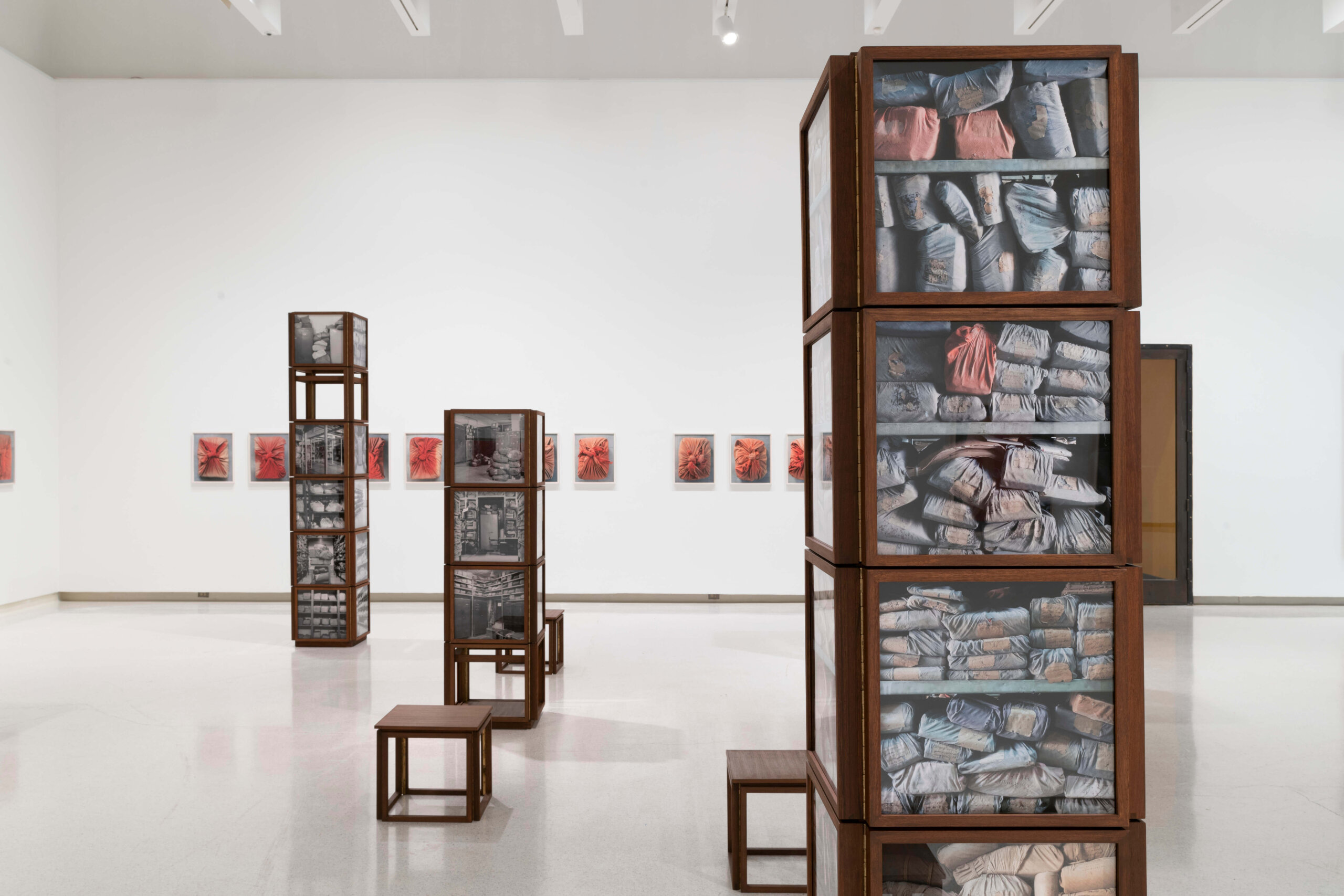
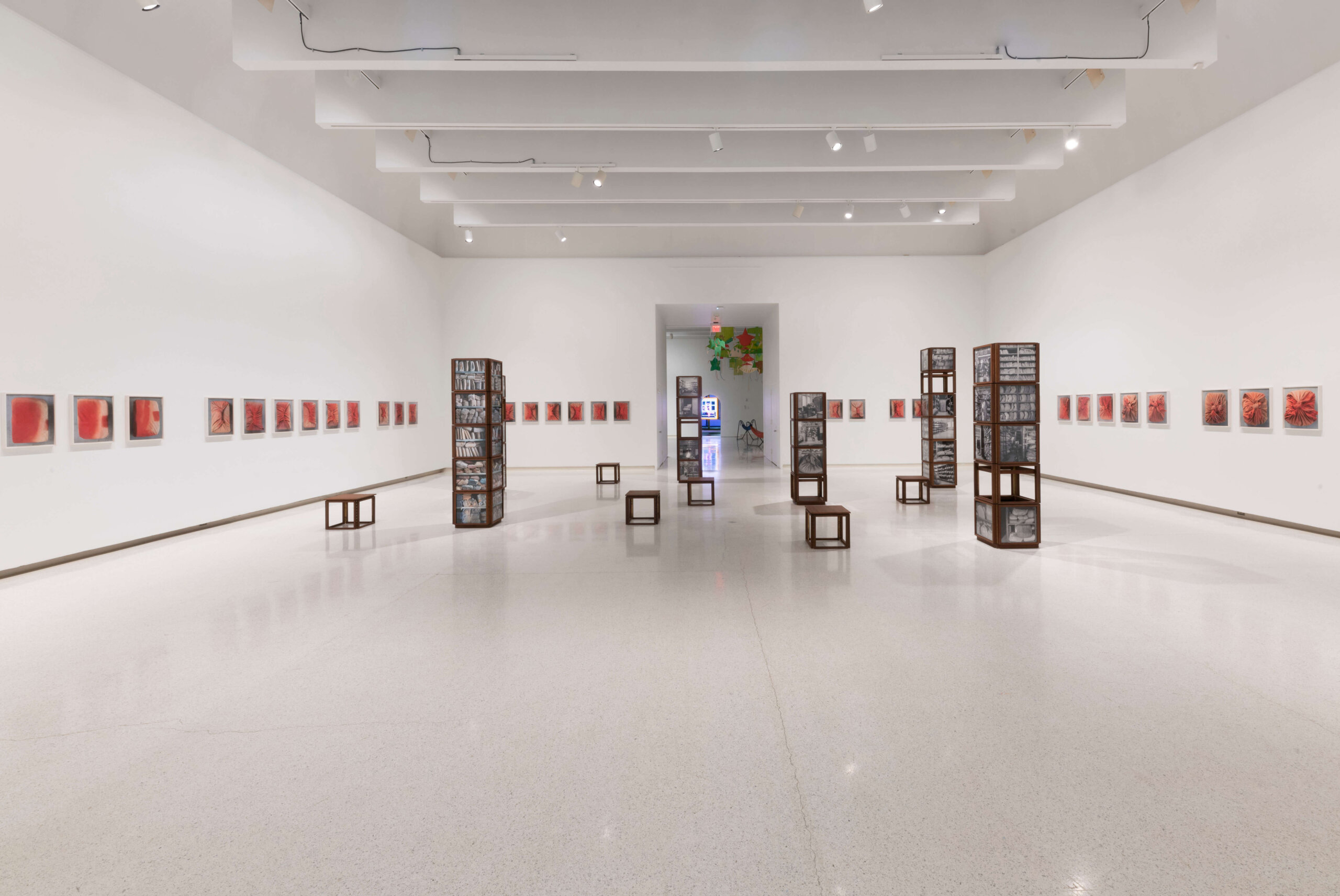
At the 2018 Carnegie International, now on view at Pittsburgh’s Carnegie Museum of Art, Singh exhibits two works marked by her unique brand of “photo architecture.” Time Measures (2016) consists of 34 images, each featuring a bundle wrapped and knotted with a bright red textile. Uniformly captured against a backdrop of stone blocks, these 34 bundles appear the same upon first glance. Indeed, Singh enforces a sense of repetition by hanging the photos—identically sized and framed—along a single line, close to eye level. The images stream across three walls of the gallery, easing around corners and across an entryway. Such a uniform band cinches the space together aesthetically, creating an architectural bundle; form thus mirrors content.
More strikingly, Time Measures traces an internal frieze that evokes the Carnegie Museum of Art’s facade. Conceived in the 19th century, the building’s neoclassical design boasts a ribbon of canonical names incised around the exterior. Aristotle, Copernicus, Rembrandt, and Darwin keep company with other great men from the Western tradition. As part of the International, artist Tavares Strachan disrupts this roll-call by inserting—via neon tubes of various hues—the names of women and people of color. His Encyclopaedia of Invisibility (2018) makes visible a fuller version of history, one that intersperses among the names of famous white men those of less familiar heroes. Singh’s Time Measures recalls Strachan’s Encyclopaedia not only in structure, by describing a frieze-like course, but also in palette: both the red bundles and electric neon letters stand in bold relief against pale grey stone. Like the names of those usually made invisible, the bundles are glyphs that deserve a closer reading.
Indeed, Time Measures rewards viewers who measure time without modern distractions. A more attentive survey, for example, reveals how subtle breaks divide the circuit of photos, defining sub-groups that contain anywhere from two images to seven. These spatial pauses articulate a staggered rhythm that literally marks time differently across the walls. What initially seemed a lyrical, sustained line now buzzes with syncopation.
This complex, shifting quality extends to the photos themselves. Knots vary slightly from one bundle to the next. Sun-bleached patches and striations render each wrapper unique. With more time and scrutiny, the bundles assume the weathered charm of people’s faces; the series begins to resemble a taxonomy of portraits, each calibrated against nearby images. Indeed, the close-up images exude such a powerful sensuality that viewers might feel tempted to reach into the frame, loosen the knots. But a click of the shutter has forever sealed each bundle.
As Singh explains, these enigmatic objects come from one of the many archives that she photographs for a long-term project. Across India, bundles are often used instead of boxes to hold papers and other materials. While most people enter an archive to peruse items retrieved from storage, the artist focuses her camera elsewhere. For Singh, the unopened bundles in her photos betray their own secrets:
I prefer to leave the contents ambiguous, as I really don’t know what’s in them or [where] they are from. What interested me was how they had measured the light that fell on them, depending on where they sat in the archives.
By reading the container rather than its contents, Singh conjures both a material history and a map of the archive. Patterns of fading outline the position of surrounding objects, while gradations of color suggest the length of sun exposure. These indelible marks transform the wrappers—generic, disposable—into artifacts of rare import. Like jigsaw pieces, the bundles help reconstruct an archive’s layout; like photographic film, they register a picture based on light and time.
By inverting the values usually attributed to objects, creating an encyclopedia of the invisible, Time Measures queries the politics of knowledge and recognition. What do we neglect to bring a certain object into focus? What do we forget to sustain a desirable version of truth? Even archives, often perceived as hermetic sites of authority, cannot escape the impact of their social and physical environs. No matter how tightly wrapped and knotted, every bundle of knowledge remains subject to changing light, changing times. Like Strachan’s neon letters, which blaze at night and fade into day, Singh’s bundles force viewers to consider how local context affects visibility.
Time Measures never makes overt reference to politics, however. Singh elegantly abstracts her images from a specific time or place, giving the series a transcendent quality. Nonetheless, the bundles have a visceral presence that implicates the materiality and messiness of the world just beyond the frame. As the artist herself suggests, the bundles might be conceived “as gifts, as newborn babies wrapped in blood-soaked cloth, or indeed as time capsules.” Missives from another place, another epoch, the bundles evoke both newborn blessings and bloody sacrifice. To borrow the words of W. B. Yeats, what rough beast slouches toward birth?
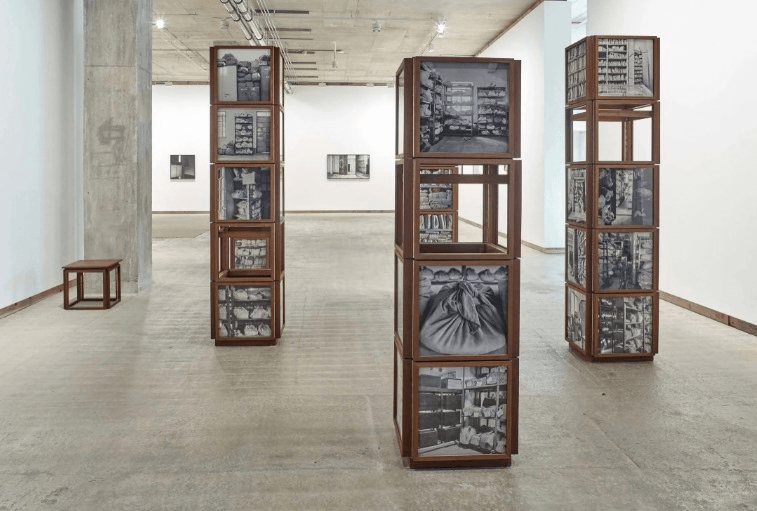
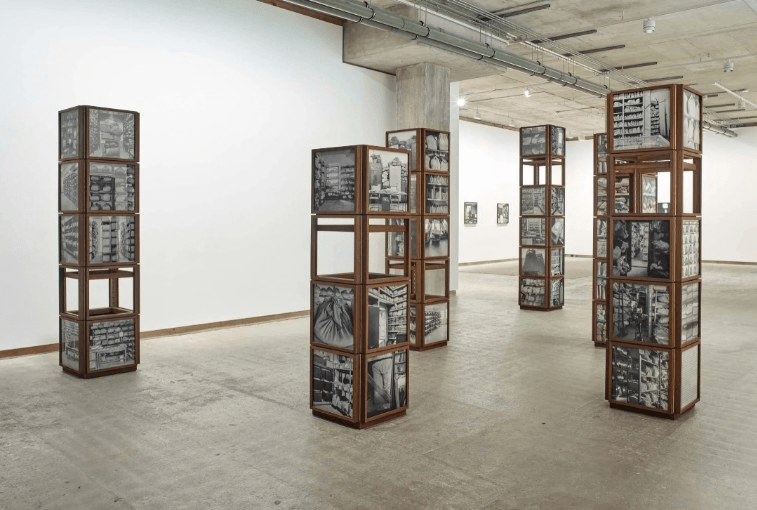
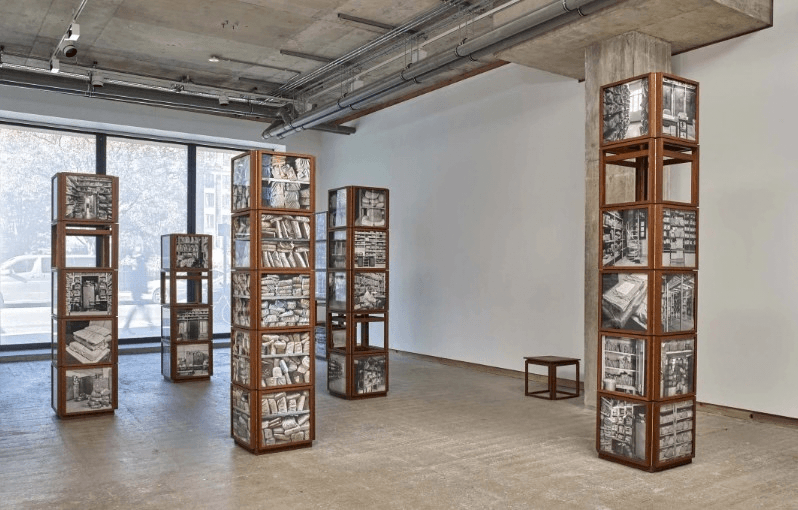
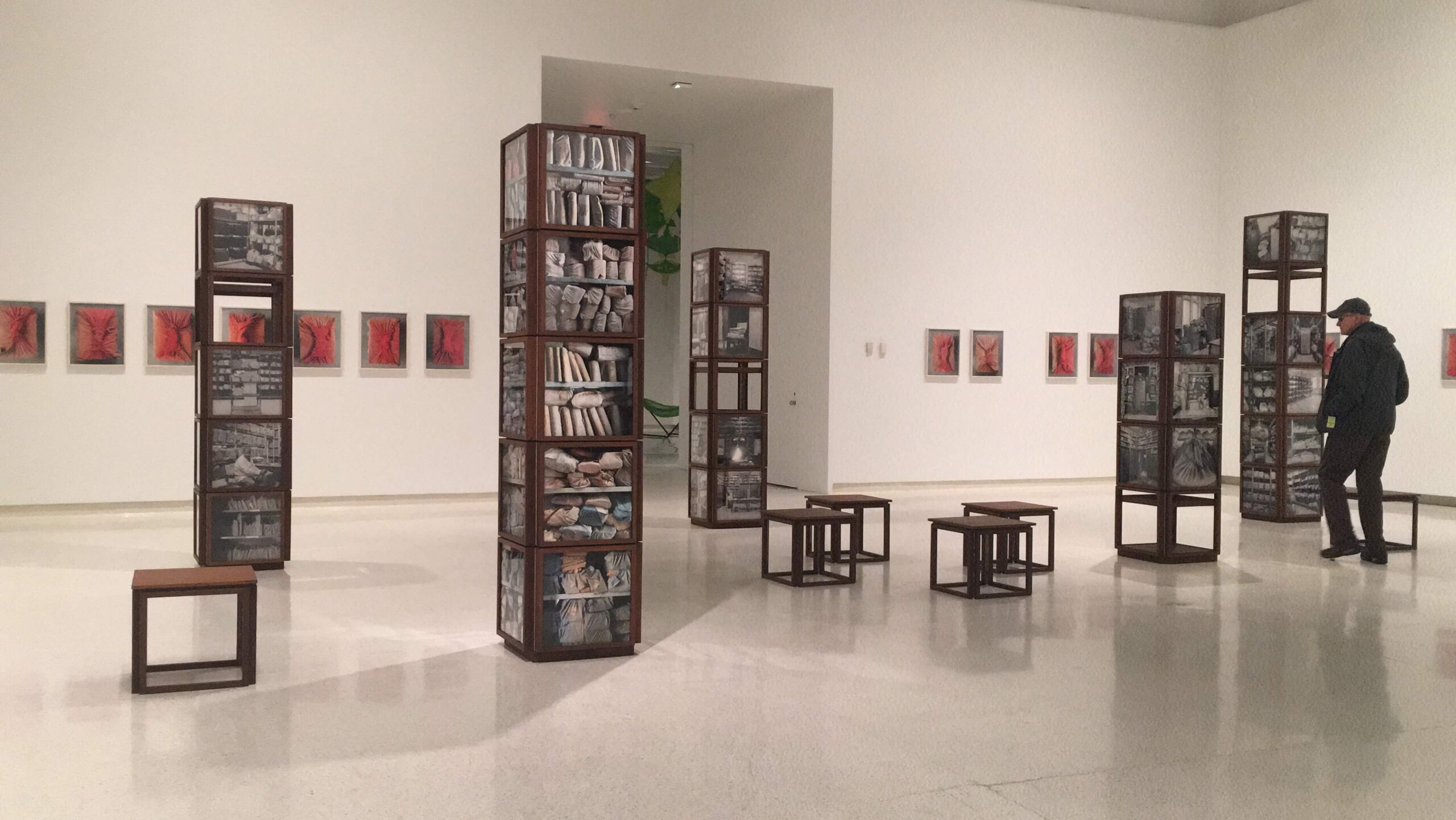
The unseen body returns to haunt Singh’s Pothi Khana (2018). While Time Measures courses around the walls, Pothi Khana occupies the floor with six towers built from large, open cubes. Lining the sides of these wood-framed structures are photos slotted into hidden grooves. Singh cleverly adopts a modular design that keeps the display flexible: anyone can rearrange the stackable cubes, swap photos, or leave slots vacant. Though such privileges remain off-limits for museum visitors, the artist hopes to empower others—such as private owners—to curate their own shows.
Singh’s work often plays with alternative modes of display. For instance, Museum Bhavan (2015) offers an impressive array of custom-built framing devices: hinged screens, groups of boxes, various furniture-like objects. Each type of device not only houses a thematic group of photos, but also forms a built space that Singh calls a “museum.” As a companion piece, the artist published a boxed set of miniature books, each indexing a specific “museum.” Between the covers, readers discover a series of images linked with accordion folds—to mimic the experience of looking at a hinged screen. Opened and standing (or positioned any number of ways), these books allow ordinary people to install and curate “museums” inside their homes.
As the artist observes: “I find the book on the bookshelf not enough for me, you know? So I want the dissemination of the book, and I want….that quality that makes things very special in a museum or a gallery.”
That special aura of a treasury—a museum, a library, a sacristy—infuses Time Measures as well as Pothi Khana. Indeed, Singh’s work consistently probes the slippage between the material and ineffable, the quantities we can measure and the qualities beyond value. Archives foreground these concerns as institutions that preserve, classify, and showcase tangible pieces of knowledge. Both Time Measures and Pothi Khana involve photos of archives, but only the latter translates structures of knowledge into architectural form. Locally, the slender towers of Pothi Khana recall the Cathedral of Learning, a University of Pittsburgh landmark diagonally across from the museum. With its medieval flourishes and soaring ceilings, this Gothic Revival skyscraper imbues higher education with the awe-inspiring mysticism reserved for a temple.
Such wonder suits the images filling the six towers. Singh’s photos—mainly black and white, some lightly tinted—depict archives packed with the kind of bundles seen in Time Measures. Shelving units display rows of wrapped and knotted parcels, their contents as mysterious as ever. But here, the lines of shelves in the photos echo the lines dividing the towers into cubes. Just as every archive protects and sorts irreplaceable artifacts, each tower collects and arranges a treasury of photos. The cubes thus serve as windows into a faraway archive while mirroring that repository’s form and function.
By mingling real and virtual shelves, Singh introduces a self-reflexivity that troubles how visitors perceive built space. Like Museum Bhavan, Pothi Khana experiments with framing devices that reorient the viewing experience. Just as the former inserts “museums” inside a museum, the latter challenges the very structure of museums from within. How do visitors encounter objects? How are meanings are produced and made legible? Singh embeds alternative spaces of display to unsettle an institution’s protocols of seeing and knowing.
Singh finds a graceful but potent way to disrupt architecture: by placing six matching stools among the towers of Pothi Khana. Sporting the same teak frames and gold hinges as the towers, these seating cubes evidently belong to a cohesive, planned landscape. As Singh explains, the stools are provided for visitors to relax, converse, study the photos at length, or simply experience the installation from a lower-than-usual angle. With a single gesture, the artist welcomes us into her domain, her allotted space in the museum. As we linger in Singh’s creative “home,” lounging on stools designed for our bodies, we become part of the work. When we leave, traces of us inevitably remain: a footprint, a hair, the warmth of a seat, a disturbance in the air.
Pothi Khana’s towers and stools transform a collection of photographs into a social, engaged space much like an archive. As Singh’s images reveal, such places do not exist as islands. While Time Measures records the visible effects of a world outside the frame, Pothi Khana shows the everyday objects used by staff who make the archive a kind of home. Desks and chairs, thermos and cups: the presence of these human comforts steer the photos from pure formalism. Yet the users of these furnishings remain stubbornly absent, off the scene, fugitive. Lest we think some disaster has struck, Singh includes one image of a bespectacled man sitting at a desk, looking sternly into the camera: an old-school librarian’s gaze.
Singh’s work reminds us that archives—and museums—cater to people. Even when hidden from view, human bodies leave traces that haunt the photos. How could a machine secure bundles so intricately? The sheer variety of knots in Time Measures suggests the effort of many hands, untying and retying bundles over years. Sitting and pondering the vacant chairs in Pothi Khana, we realize that our own bodies mirror those of the absent people. Just as the shelves formed by the towers mimic those in the photos, the stools allow us to imagine ourselves occupying a space inside the archive. We too could be seated by a table, pouring a cup of tea. We too could be unknotting a bundle, poring over a text. Might we detect a footprint, a hair, the warmth of a seat, a disturbance in the air?
The modular cubes enable viewers not only to curate their own shows, but also to project their own dramas, to place themselves in new subject positions. As a device for both framing and staging, her architecture brings the unknown into empathic proximity. Even the artist has a phantom double: several photos depict a camera on a tripod.
Amid the names written across the frieze, Strachan nestles this phrase in neon: “all the people made invisible by the mechanism of history.” While Singh has less interest in names than Strachan, her work makes visible those behind-the-scenes workers who usually toil without credit. More importantly, her work serves as a mechanism that makes us visible, to ourselves and to others. While we may not be Carnegie, or any of the famous men inscribed onto maps, into history, we too have our humble place—if only on a low, hard stool. At the same time, Singh opens up new possibilities for conceiving ourselves. As we gaze into a faraway archive, what might that bespectacled man see of us? What rough beast slouches toward birth?